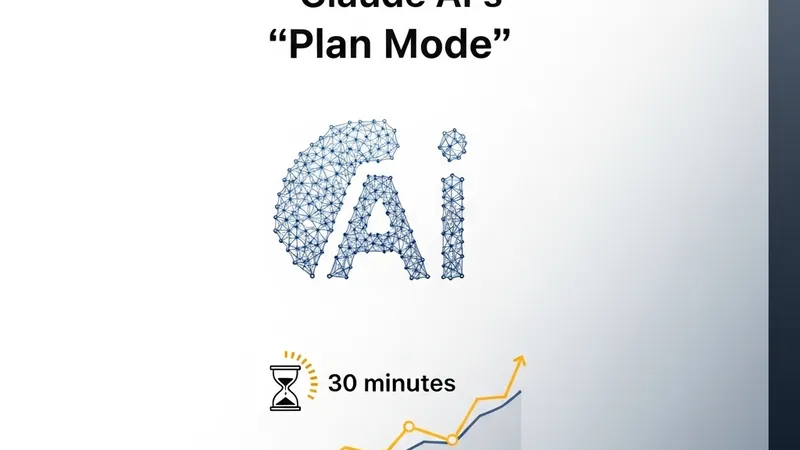
As large language models increasingly assume a pivotal role in software development, the twin pillars of efficiency and quality in AI-assisted coding tools have become central to industry discourse. Anthropic's Claude AI, particularly its "Plan Mode" for code generation, is driving a compelling discussion on the balance between speed and depth. Recent comparative research reveals that while Claude's Plan Mode might take up to 30 minutes for complex coding tasks, the quality and reliability of its output far surpass those generated by its rapid-response counterparts in as little as 43 seconds.
So, what exactly constitutes Claude's "Plan Mode," and how does it differ from conventional or faster AI code generation? Essentially, Plan Mode represents a deeper, more structured approach to thought and problem-solving by Claude. In this mode, the AI doesn't immediately churn out the final code. Instead, it emulates human developers by first decomposing the task, identifying key sub-problems, and then devising solutions for each. It engages in internal "deliberation"—generating a series of steps, reasoning through logic, and even performing mental dry runs of the code, incorporating self-correction and optimization at each stage. This stands in stark contrast to rapid modes, where the AI might quickly match prompts to generate code, potentially with less foresight.
The striking "43 seconds vs. 30 minutes" differential underscores the fundamental distinction in how these modes tackle complexity. Consider a scenario requiring the development of a backend service module involving multi-data source integration, intricate business logic processing, and specific API interactions. In a rapid mode, Claude might deliver a preliminary code framework within seconds, but this could be riddled with logical gaps, API call errors, or performance bottlenecks. When switched to Plan Mode, Claude dedicates considerably more time—perhaps half an hour—to thoroughly analyze requirements, plan data flows, design modular structures, and progressively implement and validate the code. The resulting output is typically more robust, maintainable, and adept at fulfilling complex specifications.
This significant time disparity reflects the computational overhead associated with AI's "thinking" process. Plan Mode, by integrating more reasoning steps, iterations, and self-correction mechanisms, substantially increases the computational resources and time required to complete a task. However, this is not an arbitrary investment. For projects with stringent demands on code quality, security, and scalability, or critical tasks involving complex algorithms and multi-system integrations, this investment proves invaluable. It effectively mitigates the risks of extensive debugging, refactoring, and potential production incidents down the line.
For tech professionals and AI agent developers, understanding and effectively leveraging Claude's Plan Mode is paramount. It signals that in constructing intelligent coding assistants, blindly pursuing speed should not be the sole objective. Instead, the choice of operating mode should be flexible, adapting to the task's complexity and the required quality threshold. Moving forward, combining more efficient reasoning algorithms with smarter task decomposition strategies will enable AI coding tools to strike an optimal balance between speed and quality. This will further enhance development efficiency and reduce the cognitive load on human developers. The advent of Plan Mode also offers fresh perspectives for AI agent applications such as multi-agent collaboration and complex system design.