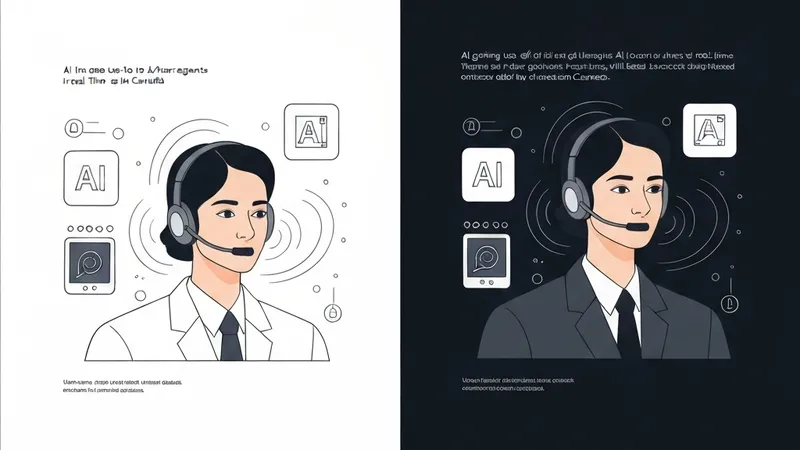
The increasing deployment of artificial intelligence (AI) to alter the accents of call center workers in real-time is generating significant concern among union leaders and academics in Canada. Critics warn that this technology could mislead customers and potentially impact Canadian jobs.
Scrutiny over AI "accent masking" has intensified in Canada after labor representatives disclosed that at least one major domestic telecommunications company is utilizing this technology. Roch Leblanc, telecommunications director for Unifor, stated to a parliamentary committee that "at least one of the three big telco companies" is employing AI to mask the accents of offshore agents, thereby altering how customers perceive the identity of the person they are speaking with.
While Leblanc did not name the specific company, Telus Digital had previously announced a partnership with an "AI-powered speech enhancement" firm on its website, aimed at "softening accents." According to Telus Digital, "Speech enhancement AI leverages cutting-edge speech-to-speech models to transform audio in real-time. These models directly modify the acoustic features of speech, preserving the speaker’s voice while improving clarity and reducing accent-related friction."
Telus did not respond to requests for comment regarding the technology. Rogers Communications and Bell Canada, when questioned by Global News, both denied using AI in this manner. Online demonstrations of AI tools illustrate how a speaker's accent can be instantly modified, enabling non-native English speakers to sound more like anglophones.
With major global hubs for call centers serving North American companies located in the Philippines and India—driven by a trend of outsourcing customer service to reduce costs—the Canadian Telecommunications Workers Alliance is escalating its concerns about this practice at the federal level.
"Canadians should know when AI is being used," Leblanc emphasized. Renee Sieber, an associate professor at McGill University, added that while the technology may appear benign, it carries broader implications: "Here’s an application that a company may say is benign, but actually could be stealing Canadian jobs."
The practice appears to be expanding globally, with Teleperformance SE, the world’s largest call center operator, reportedly rolling out similar AI technology to eliminate the accents of its Indian workers. Proponents of the technology, however, argue that these tools significantly improve communication effectiveness.