Apple made sports broadcasting history on Saturday night by shooting an entire Major League Soccer (MLS) game using iPhone 17 Pro Max smartphones. Now that the historic broadcast has successfully concluded, it is worth exploring how Apple pulled off this impressive feat and what it means for the industry.
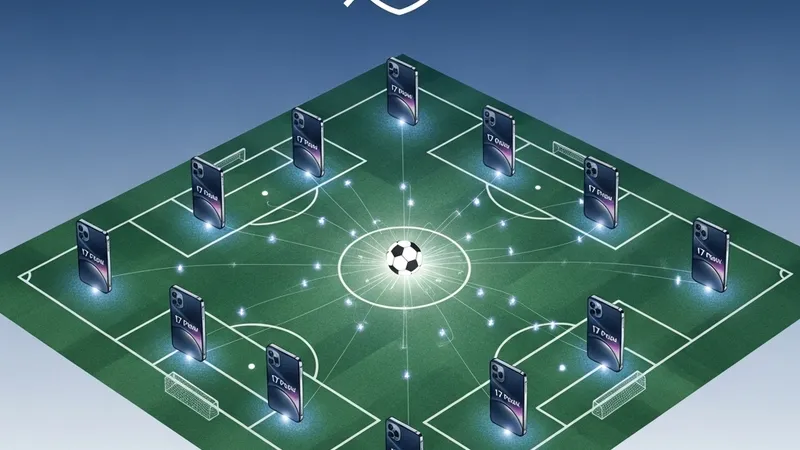
Apple shared behind-the-scenes footage from the match between the Los Angeles Galaxy and the Houston Dynamo on its social channels, offering a look at the unique camera rigs. According to Apple, they set up 15 iPhone 17 Pro Max smartphones to capture the action on the pitch and in the stands at Dignity Health Sports Park in Carson, California. The iPhone's compact size enabled the production team to place professional-grade cameras in tight spots that cannot support full-size broadcast cameras, such as on long poles and inside the nets.
Since the iPhone 17 Pro can output video via HDMI, the feeds easily integrated into Apple TV's standard MLS broadcast setup, with all smartphone footage sent directly to the on-site production truck. The final highlights looked identical to standard high-end broadcasts, which is a major achievement: delivering industry-standard professional broadcasts using a device that fits in a pocket.
However, the setup involved much more than just bare smartphones. Tech creator Brian Tong demonstrated that Apple attached some of the iPhones to massive, industry-standard Fujifilm Fujinon broadcast lenses. Seeing a mobile phone mounted to a $265,000 Fujinon HZK 25-1000mm lens was a surreal sight.
While these high-end lens configurations are far beyond what typical users would need, the on-field mobile setups were much simpler, utilizing the iPhone's built-in lenses and standard handheld rigs that enthusiast-level creators could easily replicate.
Software-wise, all 15 iPhones ran the Blackmagic Camera App, recording in Apple Log 2 at 1080p60, with some setups using iPads as external monitors. Although Apple hasn't announced plans to switch entirely to iPhone-based broadcasts for MLS, F1, or MLB, this successful experiment demonstrates the smartphone's readiness for high-end production environments. As Apple noted, the iPhone can go where traditional cameras simply cannot.
[AgentUpdate Depth Analysis] Apple's multi-iPhone live broadcast is more than an optical milestone; it showcases the potential of mobile devices acting as distributed multimodal sensory nodes. In the evolving AI Agent ecosystem, lightweight, high-fidelity endpoints like the iPhone 17 Pro Max will serve as the "distributed eyes" for embodied AI and multimodal Agents. Orchestrated by a centralized "AI Director Agent," these multiple feeds can be processed in real-time to automate camera switching, analyze player telemetry, and generate personalized highlights without human intervention. By merging edge computing, high-speed HDMI/wireless pipelines, and advanced mobile hardware, this demonstration provides a viable blueprint for spatial computing and physical-world AI agents. It heralds a future where autonomous agents can seamlessly comprehend, orchestrate, and broadcast complex physical events in real time.