The MiniCPM model family is dedicated to creating ultra-efficient, open-source artificial intelligence solutions for on-device deployment. These models have demonstrated significant speed-ups and strong performance on edge chips, and they include highly quantized BitCPM versions to further enhance operational efficiency.
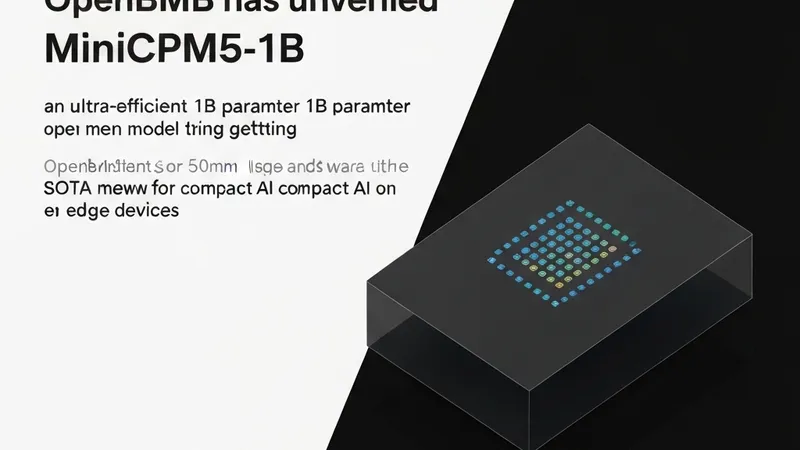
The recently launched MiniCPM5-1B represents the latest breakthrough in this series, establishing a new State-of-the-Art (SOTA) for compact open models on the edge. MiniCPM5-1B is a dense 1-billion parameter open model specifically designed for on-device and local deployment. It supports an impressive context window of up to 131K and introduces unique "Think / No Think" modes, which significantly improve inference efficiency for complex tasks.
Furthermore, MiniCPM5-1B natively supports robust tool-calling capabilities, allowing it to interact with external tools or APIs, thereby expanding its application scenarios. For deployment, the model is compatible with major formats like GGUF and MLX and supports various leading inference backends, ensuring broad applicability. Notably, MiniCPM5-1B can even power an offline desktop pet application, showcasing its potential for enabling sophisticated local AI on consumer-grade devices.
[AgentUpdate Depth Analysis]
The launch of MiniCPM5-1B is a significant catalyst for the "edge-ification" and "localization" trend within the AI Agent ecosystem. Achieving a 131K context window, tool calling, and "Think/No Think" modes with only 1 billion parameters highlights exceptional architectural and training optimizations. This positions MiniCPM5-1B as a powerful enabler for truly autonomous and private AI Agents on resource-constrained edge devices like smartphones, IoT gadgets, and embedded systems. By facilitating sophisticated local processing, it significantly enhances user privacy, reduces reliance on cloud infrastructure, and enables near-instantaneous responses. Imagine fully offline personal AI assistants capable of understanding complex commands, calling local applications, and even learning on-device. This model, alongside frameworks like Llama.cpp and GGML, paves the way for ubiquitous, personalized AI Agents that redefine user interaction and data ownership. Its compact efficiency will accelerate innovation across diverse edge applications, from smart home control and industrial automation to personalized educational tools, marking a profound shift towards an "AI everywhere, data-in-your-hands" paradigm.