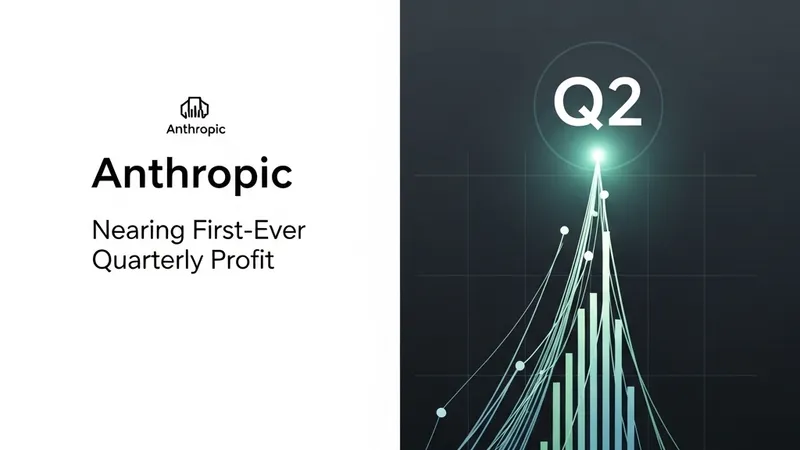
According to sources familiar with the matter, artificial intelligence startup Anthropic is on track to achieve its first-ever quarterly profit, driven by explosive demand for its generative AI software and API services.
Financial disclosures shared with investors reveal that Anthropic expects its second-quarter revenue to reach a staggering $10.9 billion, representing a more than 100% surge compared to the previous quarter. Alongside this rapid top-line growth, the company projects an operating profit of $559 million for the quarter ending in June.
As OpenAI's primary competitor, Anthropic has successfully leveraged its "Constitutional AI" framework and safety-first design to secure high-value enterprise clients in strictly regulated sectors like finance, healthcare, and software development. The rollout of its Claude 3.5 model family, combined with innovative developer tools like the Model Context Protocol (MCP), has significantly lowered the barrier to deploying production-grade AI Agents, translating directly into exponential API consumption and recurring subscription revenue.
[AgentUpdate Depth Analysis] Anthropic’s transition to quarterly profitability marks a watershed moment for the AI Agent ecosystem. For years, skeptics questioned the economic viability of LLMs due to astronomical computing costs and unclear monetization pathways. Anthropic’s financial breakthrough proves that enterprise-grade AI Agents have transitioned from conceptual novelties to core productivity drivers. By combining Claude's advanced reasoning capabilities with standard connection protocols like MCP, Anthropic has effectively bridged the gap between LLMs and enterprise legacy systems. This success will accelerate the corporate paradigm shift from simple chatbots to fully autonomous agentic workflows. Ultimately, this milestone signals that the AI industry is moving past the pure infrastructure war and entering an era focused on tangible, high-margin agentic application value.