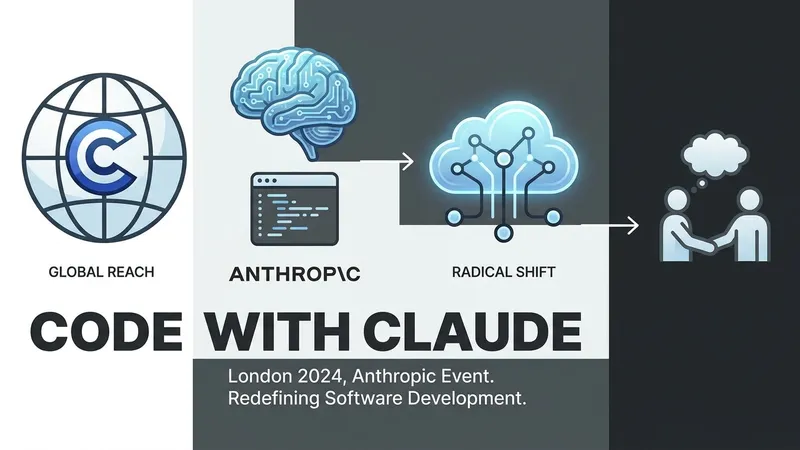
The atmosphere was electric at "Code with Claude," Anthropic’s two-day developer event in London. During a keynote, Anthropic engineer Jeremy Hadfield asked the packed room: “Who here has shipped a pull request in the last week that was completely written by Claude?” Nearly half the hands went up. He followed with a more provocative question: “Who here has shipped a pull request completely written by Claude where they did not read the code at all?” Despite nervous laughter, most hands stayed raised.
It is no longer news that LLM-powered tools like Claude Code are upending software production. Leading tech firms are now boasting about the decreasing amount of hand-written code in their repositories. “Most software at Anthropic is now written by Claude,” Hadfield stated, adding that Claude even wrote most of the code within Claude Code itself. This paradigm shift has set in with remarkable speed across the industry.
While Claude 4's coding abilities were nascent a year ago, the release of versions 4.6 and 4.7 has turned Claude Code into a tool developers are increasingly comfortable delegating to. Anthropic’s stated goal is to push automation to its limits. Instead of humans cleaning up AI-generated mistakes, the vision is for Claude to check and correct its own work autonomously.
“The default isn’t ‘I’m going to prompt Claude’—the default is now ‘I’m going to have Claude prompt itself,’” said Boris Cherny, head of Claude Code. In this setup, human developers might not even see error messages; Claude will test and tweak in a continuous loop until the software runs perfectly. As engineer Ravi Trivedi put it: “The key principle is getting out of Claude’s way. Let it cook.”
To facilitate this, Anthropic introduced a feature called "dreaming." In this mode, Claude Code agents write notes to themselves, recording and saving critical information about specific tasks. This metadata allows future coding agents to inherit context and insights, enabling a more sophisticated, multi-agent autonomous workflow.