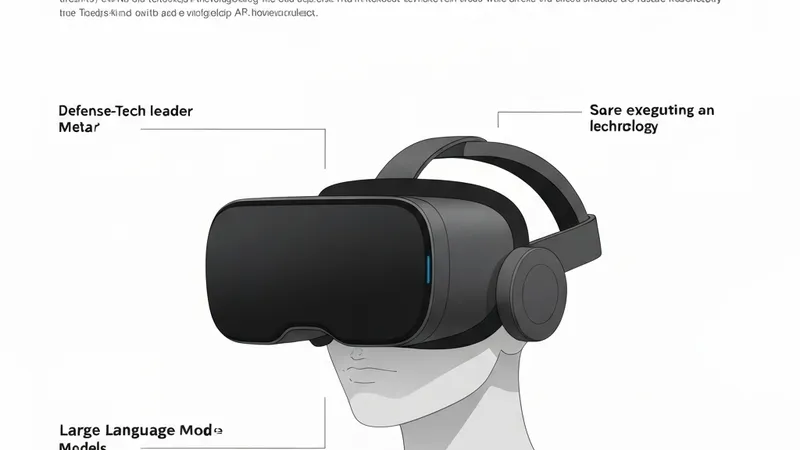
Defense-technology firm Anduril has shared new details regarding the augmented-reality headset prototypes for the military it is developing in partnership with Meta. The vision involves ordering drone strikes through eye-tracking and voice commands. Quay Barnett, a vice president at Anduril and former Army Special Operations Command officer, describes the goal as optimizing “the human as a weapons system,” a cyborg-inspired approach where soldiers and drones share intelligence and make decisions as a unified entity.
Anduril is currently managing two distinct projects. The first is the Army’s Soldier Born Mission Command (SBMC), for which the company secured a $159 million prototyping contract last year to work with Meta on AR glasses that attach to standard military helmets. Simultaneously, Anduril is self-funding a project called EagleEye, an integrated helmet and headset combo. While not yet an official military requirement, Anduril believes the Department of Defense will ultimately prefer this all-in-one solution.
Technically, the systems overlay critical data onto a soldier’s field of view, ranging from simple compasses to complex topographical maps, drone flight paths, and AI-driven target recognition. Soldiers interface with the system using plain language to execute tasks like planning evacuation routes or mission logistics. Anduril is testing Large Language Models—including Google’s Gemini, Meta’s Llama, and Anthropic’s Claude—to translate natural speech into software commands. The operational engine is Anduril’s Lattice software, which the Army recently committed $20 billion to integrate across its global infrastructure.
The headset is being designed to handle multi-step tactical workflows. A soldier might task a drone with autonomous surveillance, and upon the AI identifying a target like an artillery unit, the system would suggest courses of action for human approval. Future iterations may move beyond voice to rely purely on eye-tracking or gestures. While Microsoft’s previous $22 billion production contract for AR glasses was canceled due to technical failures, Anduril anticipates its systems could move into production by 2028.