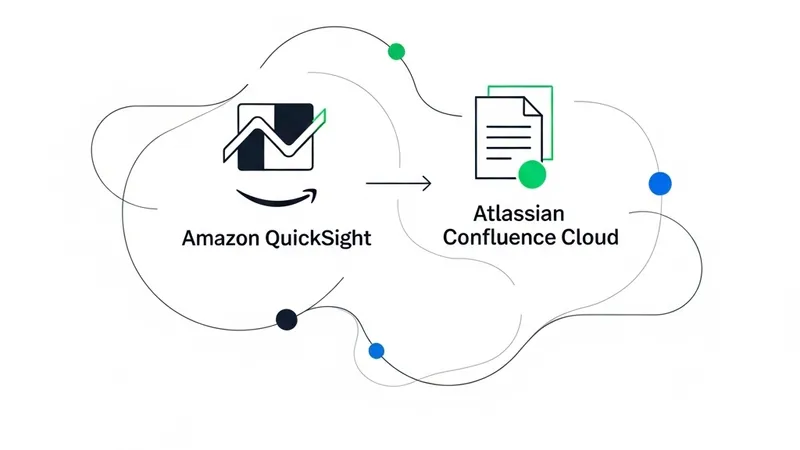
Teams can now integrate Atlassian Confluence Cloud with Amazon Quick to search and manage documentation without the friction of switching between multiple systems. When critical documentation resides in Confluence while related data sits in disparate systems, teams often lose productivity by manually gathering context. These interruptions slow down decision-making and create gaps between institutional knowledge and actionable insights.
The direct integration with Confluence Cloud mitigates context switching by making Confluence content searchable through natural language queries directly within the Quick interface. Teams can query pages, retrieve technical documentation, and update content while simultaneously accessing data from other integrated systems such as Amazon S3, Atlassian JIRA, or other enterprise applications.
Setting up the Confluence Cloud integration involves several key components: creating a knowledge base for semantic search, configuring Actions to manage Confluence pages, and organizing resources within Quick Spaces. Quick is designed to integrate with modern enterprise stacks, ranging from internal wikis to AWS data services and business-critical applications.
These integrations are categorized into three functional areas: Actions for executing tasks across applications, Knowledge Bases for indexing unstructured content like documents, and Topics/Datasets for natural language querying over structured data sources like Amazon Redshift. Actions connect Quick to external systems at the moment of query, allowing users to read, write, and automate tasks directly.
There are three primary pathways to establish an Action integration: utilizing a built-in connector for popular tools like Confluence and Salesforce; implementing a custom REST API using an OpenAPI specification; or leveraging a Model Context Protocol (MCP) server. The MCP approach offers a flexible, standards-based method for dynamic tool discovery. Meanwhile, Knowledge Bases index content prior to user queries, ensuring that wikis and documents are instantly searchable via semantic retrieval rather than real-time fetching.