Author and illustrator Loryn Brantz never imagined that a popular cartoon character she created nearly a decade ago would become the center of an intellectual property dispute involving BuzzFeed, Amazon’s Prime Video, and generative artificial intelligence. Yet, that is precisely the reality she faces today.
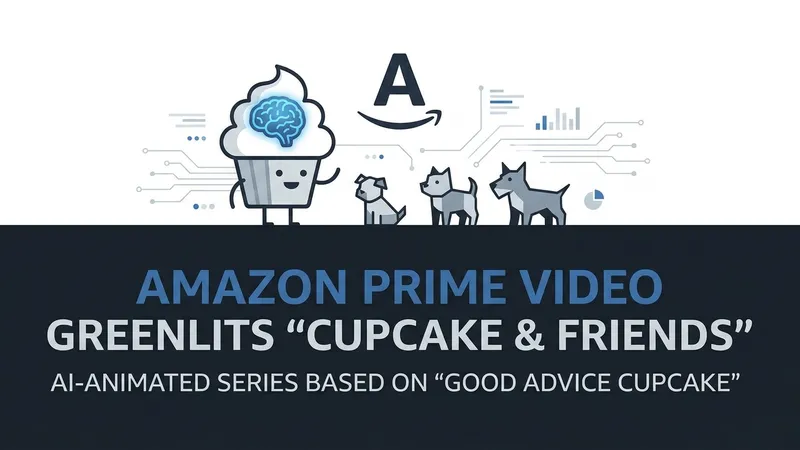
"Nothing said in good faith by managers and executives was followed through with," Brantz said of BuzzFeed, her former employer. This week, Brantz shared an Instagram post calling out the once-dominant media brand. Her outrage followed news that BuzzFeed had licensed her advice-giving cupcake character, Cuppy (from "The Good Advice Cupcake"), to Prime Video. The streaming giant plans to release a series called "Cupcake & Friends," developed using AI tools. The project is one of three new animated shows greenlit through the GenAI Creators’ Fund, a joint initiative of Amazon Web Services (AWS) and Amazon MGM Studios.
"This is an assault on artists everywhere," Brantz declared in her post.
The headlines announcing the project were a nightmare come true—a scenario that creative professionals have increasingly dreaded in the age of AI. Digital media companies, heavily restructured over the years, have become fertile ground for such licensing deals. Recently, media mogul Byron Allen became BuzzFeed’s chairman and CEO after purchasing a majority stake for $120 million, detailing plans to leverage AI to transform the platform into a competitor for YouTube.
Brantz, a former executive creative director for the popular YouTube educational channel Ms. Rachel, blasted BuzzFeed and Amazon for turning her creation into a "soulless AI puppet." "I encourage you to boycott BuzzFeed and any AI-produced or adjacent animation," she wrote on Instagram.
Brantz joined BuzzFeed in 2014 during the peak of its digital influence. While there, she worked on her own books and shared original comics on social media. In 2017, her comic featuring an innocent-looking, anthropomorphic cupcake went viral. The character's charming demeanor would violently shift as she delivered aggressive motivational advice like, "when life gets you down, you gotta grab it by the balls—and make life your bitch."
"The character is 100 percent based on my own personality as being someone who is aggressively optimistic and nearly pathologically positive," Brantz told WIRED. "It was a way for me to yell motivational advice at people in a cute and humorous way."
Initially, Brantz conceived Cuppy for a children's book pitch. After a Disney publishing imprint rejected the idea, she incorporated the cupcake into her webcomics. Once it exploded in popularity, BuzzFeed saw a major business opportunity. "From there, there was a lot of back and forth on how to move forward animating it as a web series at BuzzFeed," Brantz recalls. Ultimately, BuzzFeed produced eight episodes of the "Good Advice Cupcake" web series, which ran through the summer of 2019, covering topics ranging from dealing with messy lives to offering personal advice.
[AgentUpdate Depth Analysis] This dispute underscores a critical friction point in the evolution of the AI Agent and multimodal content creation ecosystem. As generative AI and video generation technologies mature, AI Agents are transitioning from productivity assistants to autonomous 'creative agents' capable of scripting, animating, and scaling content production. For platforms and IP holders, leveraging AI Agents to repurpose established IP represents an incredibly cost-effective commercial strategy. However, for human creators, this process risks divorcing an IP from its emotional core, transforming intimate art into clinical, algorithmic output. For the AI Agent ecosystem to thrive long-term, we must move beyond pure technological capability and establish fair IP licensing frameworks and collaborative revenue-sharing models. AI Agents should function not as replacements for human creativity, but as collaborative amplifiers. Establishing this balance is imperative for the sustainable growth of next-generation AI media.