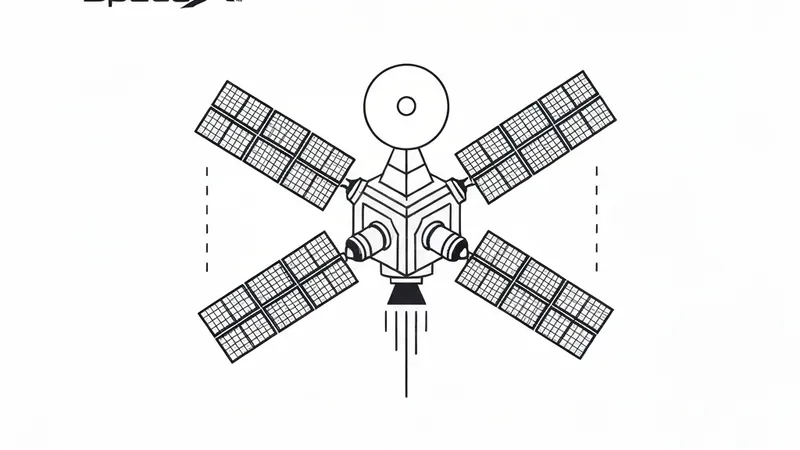
SpaceX has officially secured a massive $4 billion contract from the U.S. Department of Defense to develop and deploy the next-generation military satellite constellation known as 'Golden Dome.' This milestone agreement represents one of the largest defense contracts ever awarded to SpaceX, underscoring the military's accelerating reliance on low-Earth orbit (LEO) space architectures for national security.
The 'Golden Dome' initiative is designed to establish a highly resilient, low-latency missile warning and tracking constellation. Positioned in LEO, these satellites will be equipped with advanced infrared sensors and optical imaging payloads to track hypersonic threats and ballistic missiles globally in real time. Leveraging its extensive experience from Starlink and its defense-focused Starshield division, SpaceX will oversee the manufacturing, payload integration, and rapid launch deployment of the constellation.
Technically, the 'Golden Dome' satellites will feature high-speed Laser Inter-Satellite Links (LISLs), enabling instantaneous data routing across the constellation without relying heavily on ground stations. Industry analysts note that this contract further consolidates SpaceX’s dominance in the defense aerospace sector, presenting a significant competitive challenge to traditional defense contractors like Lockheed Martin and Northrop Grumman.
[AgentUpdate Depth Analysis] The deployment of massive constellations like 'Golden Dome' signals a paradigm shift toward Space Edge Computing, where autonomous AI Agents are becoming mission-critical. Operating hundreds of satellites in LEO requires decentralization; traditional ground-control cannot handle real-time threat detection and collision avoidance. In this next-gen architecture, each satellite acts as a localized AI Agent, forming a collaborative Multi-Agent System (MAS). These spaceborne agents will perform real-time sensor fusion and autonomous task allocation directly in orbit. This evolution will accelerate the development of radiation-hardened, low-power AI accelerators and expand the boundary of AI Agent ecosystems from terrestrial servers to distributed orbital intelligence networks.