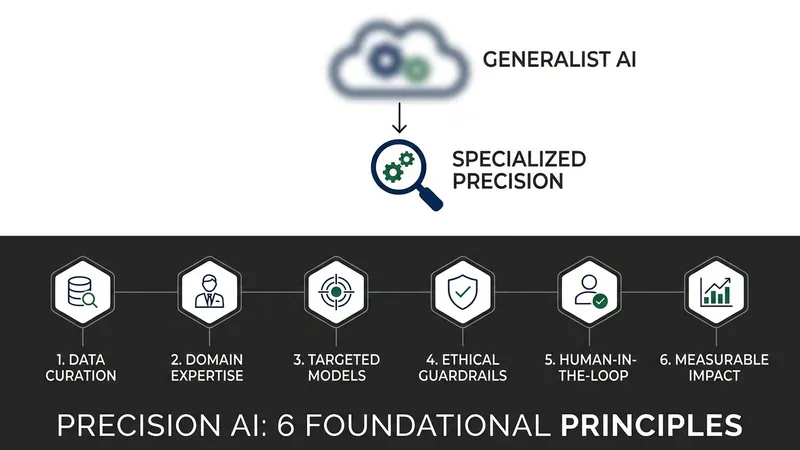
In the modern business landscape, AI agents are transitioning from experimental concepts to core production drivers. A recent case study demonstrated how a team of 20 specialized AI agents successfully replaced a workflow previously requiring 13 human employees, showcasing a monumental leap in operational efficiency. To replicate this success, developers must adhere to six foundational design principles.
First, AI agents represent a brand-new distribution channel. This necessitates a shift from UI-centric to API-centric software design. Traditional SaaS platforms are optimized for human clicking and navigation, but agents thrive on structured data. Software must now be built with machine-readable APIs in mind—designing systems that agents naturally 'prefer' to use over traditional interfaces.
Second, generalist AI approaches often fail in commercial settings. Success requires building tools that are 'one inch wide and a mile deep.' Instead of creating a jack-of-all-trades, focus on extreme specialization within a specific capability. This depth ensures the agent can handle the complex edge cases that typically break automated workflows.
Third, consistency is far more valuable than occasional brilliance. In a business production environment, an agent that provides predictable, reliable results 100% of the time is infinitely more useful than one that is occasionally creative but prone to hallucination. Reliability is the cornerstone of trust in AI-driven operations.
Furthermore, developers must rethink the 'user interface' for agents. This means providing robust toolkits with precise metadata, clear docstrings, and structured error handling. When an agent encounters a problem, it needs programmatic feedback to self-correct and continue its mission without human intervention.
Finally, the future of AI ROI lies in multi-agent orchestration. Decoupling complex processes into a pipeline of specialized agents is more scalable and cost-effective than relying on a single large model. This modularity allows for easier debugging, faster updates, and a level of organizational flexibility that was previously unattainable with human-centric teams.