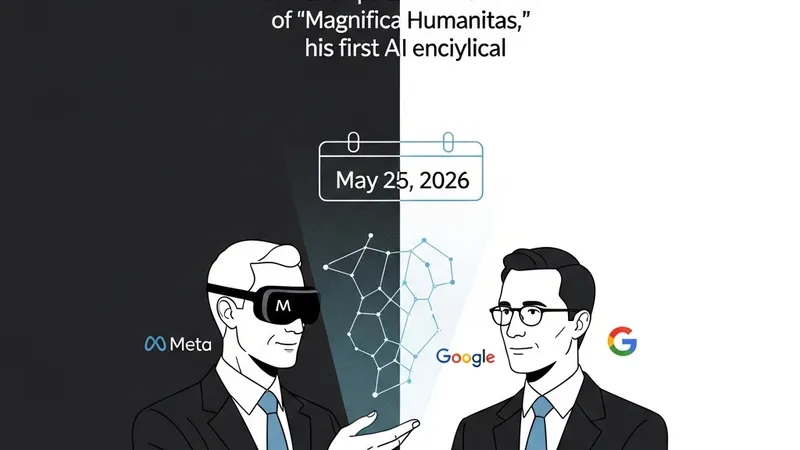
Pope Leo XIV has officially released his first encyclical on artificial intelligence, titled "Magnifica humanitas" (Magnificent Humanity). This landmark document marks a powerful intervention by the head of the Roman Catholic Church, calling for robust global AI regulation, the protection of children against hypersexualized AI-generated images, and warnings against the concentration of technological power.
However, behind this high-minded manifesto lies a web of quiet corporate influence. According to sources familiar with the matter, executives from Meta, Google, and Amazon quietly met with Vatican officials on April 29. This unpublicized meeting was part of a strategic lobbying push ahead of the encyclical's release, as Silicon Valley sought to manage its impact and align their corporate narratives with the Vatican's moral authority.
Interestingly, the tech giants' approaches to religious alignment are diverging. As reported by the Washington Post, generative AI pioneer Anthropic has increasingly aligned its ethical frameworks with the Vatican, at times prioritizing these principles over domestic policies advocated by the White House. This highlights a growing trend of AI companies seeking ethical validation from global institutions to bolster their credibility.
[AgentUpdate Depth Analysis] The intense lobbying around the Pope’s encyclical signals a paradigm shift in AI alignment from purely technical RLHF to global moral and political alignment. As autonomous AI Agents transition toward agentic workflows with real-world decision-making capabilities, the definition of their moral core becomes highly contested. Tech giants are seeking the Vatican’s ethical seal of approval to pre-emptively bypass fragmented, heavy-handed state regulations. For the AI Agent ecosystem, this implies that future Agent architectures may need to implement modular 'ethical layers' or 'moral prior plugins'—potentially integrated via standard protocols like the Model Context Protocol (MCP)—to dynamically adapt to diverse socio-cultural and religious environments. Ultimately, the battle over AI morality will directly shape how agentic systems are programmed to reason, act, and resolve ethical dilemmas globally.