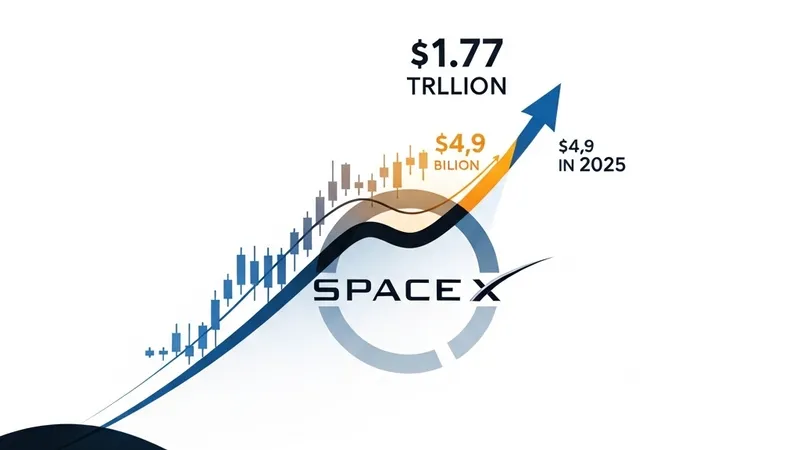
“Our mission,” says the opening sentence of SpaceX’s listing document with a straight face, “is to build the systems and technologies necessary to make life multi-planetary, to understand the true nature of the universe, and to extend the light of consciousness to the stars.” The last bit has an echo of WeWork’s infamous pitch, but if Elon Musk could tick off all these items, a case could be made for a $1.77 trillion valuation.
Unfortunately, there is the small matter of the here and now. SpaceX made a loss of $4.9 billion in 2025 on revenues of $18.7 billion, pricing its arrival on the Nasdaq market at almost 100 times those revenues. That is an otherworldly, if not absurd, valuation, even before factoring in the multi-year spending requirements of AI and multi-planetary adventures.
However, SpaceX’s established space technology is undeniably market-leading. The main attraction is Starlink, which contributes 60% of revenues and holds a commanding position in satellite broadband connectivity worldwide. This is enabled by SpaceX’s market-leading reusable technology, which has reduced rocket launch costs to “the tens of millions” from billions historically.
But those two divisions, even on a generous view, don’t get the valuation close to the trillion-dollar mark. The real premium is being ascribed to xAI, the artificial intelligence operation folded into SpaceX earlier this year. Valued at $250 billion at the time of merger, xAI will receive the lion's share of the cash raised in the IPO to expand its horizons.
While the social media platform X attached to xAI is considered a Musk indulgence, there is long-term potential value in the revolutionary concept of putting space-based AI datacenters into orbit.
Add it all up, and it’s hard to disagree with Morningstar’s analysis that SpaceX’s true value is closer to $780 billion. “We think the company has been significantly overvalued and investors will have opportunities to buy the stock at more attractive levels after the IPO,” it says. Yet, the "Musk factor" and Wall Street's momentum will likely overcome traditional valuation metrics initially.
[AgentUpdate Depth Analysis] The consolidation of xAI into SpaceX is not merely a financial maneuver but a strategic precursor to the expansion of the AI Agent ecosystem into the physical and interplanetary realms. Compared to tech giants like Google DeepMind and OpenAI, xAI possesses a unique advantage: direct integration with SpaceX’s unparalleled physical infrastructure. As AI Agents transition from software automation to embodied intelligence, they will demand unprecedented computing power and continuous global connectivity. The convergence of space-based AI datacenters and the Starlink constellation creates a futuristic blueprint for ultimate edge computing. This infrastructure will allow autonomous agents to operate seamlessly across the globe and in orbital environments. SpaceX is evolving into a foundational compute-hardware layer for physical-world AI, fundamentally altering the trajectory of autonomous systems and the agentic ecosystem.