After five decades building analytics and decisioning software for highly regulated sectors such as banking, insurance, government, and manufacturing, SAS is now betting that governance will serve as its primary moat in the emerging AI agent era. As AI agents fundamentally reshape enterprise software consumption, SAS's deep domain expertise and robust governance frameworks are positioned to retain their value, irrespective of which specific AI model or agent architecture ultimately prevails.
During his keynote at SAS’ Innovate ’26 conference, SAS CTO Bryan Harris articulated the company's long-standing mission: “We empower people with technology to scale human observation and decision making. Since the beginning, SAS has been pioneering technological breakthroughs to help you close the information gap and gain a competitive advantage.”
However, in this age of AI, businesses—especially SAS’s clientele—require the ability to trust AI and AI agents. Harris argues that it is SAS’s responsibility to ensure that even non-deterministic large language models can deliver verified and validated trustworthy results.
Harris further emphasized in a press briefing: “Our role is to really make sure we can give you a trusted answer in the moments that matter with our software—and agentic AI is just another evolution of that technology.”
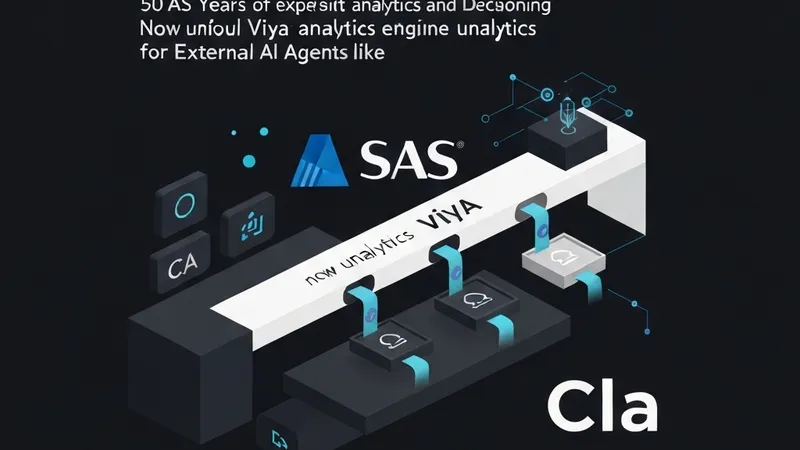
A pivotal, though perhaps understated, component of SAS’s overarching strategy is the new Viya MCP Server. This server exposes SAS’s powerful analytics and decisioning capabilities as callable tools for any external AI agent via the Model Context Protocol (MCP). Viya itself is SAS’s cloud-native data and AI platform.
Organizations leveraging AI agents like Claude, Copilot, or custom-built agents can utilize this MCP server to directly invoke SAS models, such as a fraud detection algorithm or a supply chain optimization routine. Crucially, all these operations occur without bypassing the stringent governance and data controls that SAS embeds around its models.
While many vendors adopting MCP focus on building agents that consume tools through the protocol, SAS’s more significant contribution is exposing its own analytics engine as the service agents call. This strategically positions Viya not merely as an orchestrator but as a governed backend—the trusted repository for reliable models, regardless of the initiating agent.
The MCP server was not SAS's sole agent-related announcement. The company also introduced an Agentic AI Accelerator, an open-source framework designed for building governed agents. Furthermore, it unveiled a multi-agent system within its CI360 marketing platform and a Supply Chain Agent engineered to compress multi-day sales and operations planning cycles into continuous optimization.