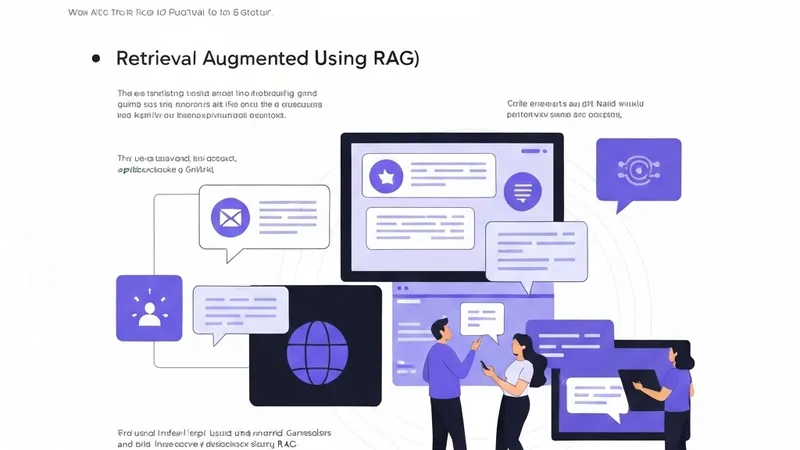
In the evolving landscape of AI development, OpenAI has introduced Assistants, leveraging Retrieval Augmented Generation (RAG) to enable AI models to access custom information. This feature represents OpenAI's foray into a technique widely refined within open-source libraries like Langchain, aiming to augment an AI's knowledge base with specific, user-provided data.
OpenAI's RAG tool, particularly its Assistants with Retrieval, offers a valuable platform for developers. Its key advantages include remarkable ease of use, significantly reducing setup time for experimentation. This accessibility allows a broader range of developers to explore how LLM retrieval can enhance workflows. Furthermore, the tool demonstrates respectable accuracy. In a test replacing a custom GPT-3.5-turbo model with an OpenAI Assistant, the accuracy level remained similar, achieving approximately 75%. This capability enables the rapid deployment of custom chatbots with high reliability.
However, as a beta offering, the OpenAI Assistants API has several limitations. A critical missing feature is source citation, which is vital for building user trust and verifying information. Additionally, the platform imposes significant document limitations, supporting only 20 documents, each up to 512 MB. This constraint makes it unscalable for most enterprise datasets. For smaller datasets, the anti-pattern of combining multiple smaller files into one larger file can lead to a loss of structure and context. Another current drawback is the lack of extensive customization options, limiting its adaptability for more complex scenarios compared to mature open-source RAG solutions.