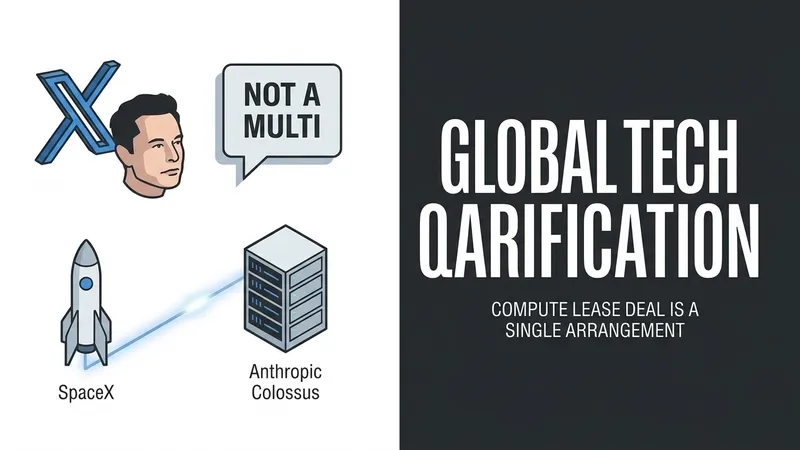
Elon Musk clarified on X that SpaceX's recent major compute deal with Anthropic could end abruptly if his own business ventures require additional computational power.
On Thursday morning, the billionaire wrote on X that SpaceX has "not committed to leasing Colossus for years" to Anthropic, clarifying that the current AI compute arrangement is structured as a 180-day lease, with 90-day mutual cancellation rights after that initial period.
This clarification does not contradict the key revelations in SpaceX's recently filed S-1 document, but it significantly sharpens the caveat surrounding the transaction. Within the 277-page financial disclosure, SpaceX reported a massive $1.25 billion-a-month deal with Anthropic for compute access from its Colossus data centers running "through May 2029." If sustained in full, this agreement could have generated over $40 billion in revenue for SpaceX. However, the S-1 filing also contained a critical clause noting that the "agreements may be terminated by either party upon 90 days' notice."
Musk's social media post adds critical context to what this means for SpaceX: while Anthropic may have agreed to pay through 2029, SpaceX has not bound itself to providing the hardware for the long term. For SpaceX, the agreement stood out as one of its most prominent potential revenue streams.
[AgentUpdate Depth Analysis] Compute power remains the ultimate bottleneck in the scaling of advanced AI Agents, and the volatility of this SpaceX-Anthropic deal highlights the fragile geopolitics of AI infrastructure. For Anthropic, relying on a competitor-linked entity like SpaceX's Colossus cluster introduces significant structural risks. While the short-term compute burst is crucial for training future Claude iterations and developing sophisticated agentic workflows, the lack of long-term guarantees leaves Anthropic vulnerable to sudden resource reallocation. In contrast, competitors like OpenAI leverage deeply structured, long-term infrastructure partnerships (e.g., with Microsoft), ensuring a predictable runway for sovereign AI Agent deployment. This scenario demonstrates that as AI Agents transition from passive chatbots to autonomous, always-on computational systems requiring continuous, high-throughput inference, owning or rigidly securing dedicated physical infrastructure will become the definitive moat separating dominant Agent ecosystems from transient ones.