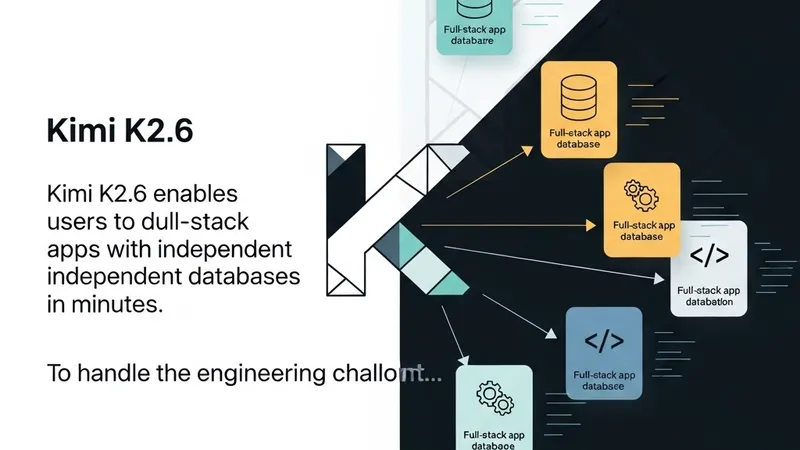
Imagine typing a simple prompt in Kimi K2.6's Agent mode: "Build me a reading notes website with login, search, and export features." Within minutes, instead of getting raw Python code to debug, you receive a live, production-ready URL. Kimi handles everything—from development and hosting to database management. However, behind this seamless user experience lies a massive engineering challenge: if one million users run this prompt, the backend must instantly provision and support one million independent production databases handling real user writes. In a traditional database paradigm, balancing cost, scale, and performance under this "impossible trinity" is practically unfeasible. How did Kimi break through this barrier?
For AI website-building scenarios, traditional cloud infrastructure faces three major bottlenecks. First, database granularity must be "one instance per end-user," making traditional hosting models cost-prohibitive when scaling to millions of tenants. Second, the database schema is generated dynamically by LLMs in real-time; subsequent user prompts to add features require live schema migrations without corrupting existing data. Third, the system encounters extreme load variance where most databases remain completely idle, while a viral application can instantly trigger a hundred-fold spike in traffic. Traditional workarounds, such as using a single PostgreSQL instance partitioned by schema, fail at scale due to performance degradation, noisy-neighbor issues, and complex rate limiting.
To overcome these obstacles, Kimi chose TiDB Cloud, implementing three key architectural decisions:
First, extreme cost reduction via Serverless multi-tenancy. TiDB Cloud decouples physical database provisioning from idle tenants. A persistent DB Session Gateway maintains connection states, and physical compute resources are dynamically provisioned only when actual queries are received, making the "one-database-per-user" model economically viable.
Second, a unified technology stack. Instead of forcing LLMs to orchestrate multiple clients (SQL, NoSQL, Vector) and manage complex transaction mergers, TiDB allows LLM-generated code to execute vectorized searches, JSON processing, filtering, and sorting within a single SQL query. This significantly reduces code-generation error rates.
Third, Warm Pools and Scale-to-Zero. To eliminate minutes-long database provisioning times, TiDB Cloud maintains a "Warm Pool" of pre-configured starter instances. When Kimi requests a database, an instance is allocated in under a second. Combined with scale-to-zero capabilities, computing costs for inactive instances are virtually eliminated.
This is not an isolated event. Platform data shows that over 90% of newly created clusters on TiDB Cloud are now provisioned directly by AI Agents rather than human engineers, signaling a major paradigm shift in modern database infrastructure.
[AgentUpdate Depth Analysis] The evolution of AI Agents from code generation to full-lifecycle application hosting marks a paradigm shift in AI infrastructure. Kimi’s integration with TiDB Cloud highlights a critical transition where LLMs demand highly elastic, stateful backends capable of provisioning resources instantly. Traditional database architectures are fundamentally incompatible with the "one database per user" model due to cost and cold-start latencies. TiDB’s Serverless multi-tenancy and scale-to-zero capabilities successfully demonstrate that database-as-a-service (DBaaS) must evolve alongside cognitive models. In the Agent era, infrastructure consumption will pivot from manual, static provisioning to dynamic, autonomous scheduling by AI Agents. The ultimate winner in AI infra will not just offer raw performance, but the ability to act as an ultra-low-latency, cost-effective, and LLM-friendly state coordinator.