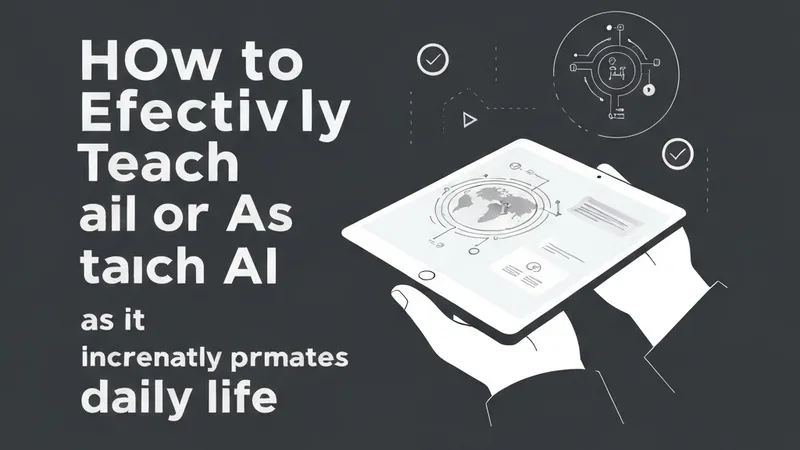
Students are increasingly exposed to artificial intelligence (AI) through everyday tools like search engines, writing assistants, and social media. This widespread exposure raises a fundamental question: What should students learn about AI? This objective is often encapsulated as #AI literacy, which combines conceptual understanding with responsible use and critical judgment regarding AI.
A more practical consideration is where AI learning should be placed within the curriculum. While approaches vary, teaching AI literacy in schools builds upon existing provincial requirements for digital technologies education. The chosen curricular model significantly influences the time allocated for learning, assessment methods, and the necessary teacher preparation.
The implications of AI literacy for schools are substantial. Several provinces and educational associations are developing or have already established frameworks for K-12 AI education. The United Nations Educational Scientific and Cultural Organization (UNESCO) envisions AI literacy encompassing both technical understanding and ethical awareness, aiming to cultivate students as AI co-creators and responsible citizens. The U.S.-based AI4K12 framework outlines what students should learn across grade levels, identifying five core ideas: perception, representation and reasoning, learning, natural interaction, and societal impact. Similarly, the U.S.-based International Society for Technology in Education (ISTE) proposes standards that empower students as learners, computational thinkers, innovative designers, and digital citizens.
Across various regions, digital learning is integrated through different curriculum models, often with provinces combining approaches. Each model supports AI literacy but creates distinct conditions for instructional time, assessment, and teacher readiness.
One such model is a 'dedicated subject or domain,' where digital skills or computer science are offered as standalone courses. In these systems, teachers are typically specifically trained for the subject, which generally supports clearer sequencing across grades and more consistent assessment. For instance, British Columbia incorporates technology education from kindergarten to Grade 9.