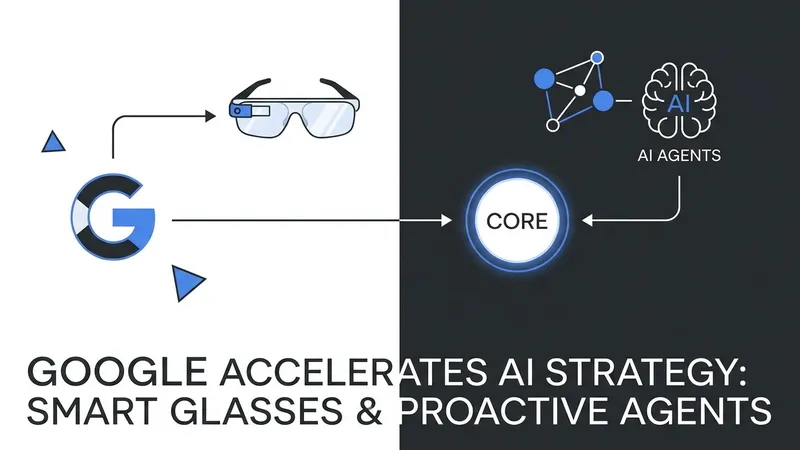
Google is preparing a significant escalation in its artificial intelligence strategy, aiming to transform the search experience from passive information retrieval into active task execution. According to sources familiar with the matter, the tech giant plans to introduce "AI Agents" into its core search engine and is concurrently developing next-generation smart glasses hardware.
This move represents a fundamental paradigm shift for Search. Future iterations of Google Search are expected to go beyond listing links or summarizing facts, evolving into personal assistants capable of performing complex multi-step tasks such as booking travel, completing purchases, or managing calendars. At the heart of this transition is Google's Gemini large language model, which provides the reasoning capabilities necessary for these agents to function. To complement these software advancements, Google is working on a hardware prototype, potentially linked to its Project Astra vision, to challenge the growing smart glasses market.
In the hardware sector, Google is directly competing with Meta, whose Ray-Ban Meta smart glasses have seen unexpected success. Google’s forthcoming glasses are expected to feature multimodal visual intelligence, enabling users to interact with their environment via voice and gesture for real-time translation, object identification, and contextual notifications. By merging AI agents with wearable hardware, Google seeks to create a seamless ecosystem where AI assistance is integrated into every aspect of a user's daily life.
Industry analysts suggest that the competition in the search and AI domain has reached a fever pitch. With the rise of startups like OpenAI and Perplexity, the traditional search business model is under siege. By deploying agents capable of taking actions, Google is not only defending its ad-based empire but also attempting to lead the "proactive computing" era. The success of this strategy will depend on how Google balances deep AI integration with growing concerns over user privacy and data security.