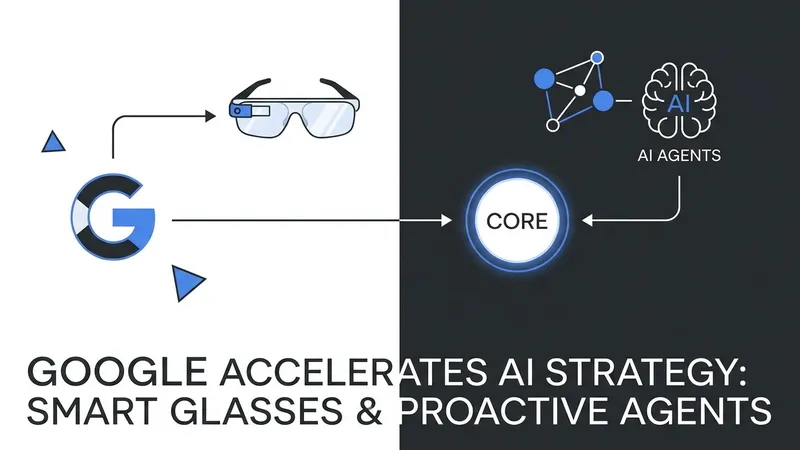
According to sources familiar with the matter, Google is planning to release next-generation AI-powered smart glasses and deeply integrate actionable AI "agents" into its flagship search engine. This double-pronged strategy marks one of the most significant technological transitions in the tech giant's history, moving from passive information retrieval to active execution.
On the hardware front, Google is actively developing smart glasses, potentially partnering with major eyewear manufacturers. These glasses will be powered by Google’s Gemini multimodal models, leveraging "Project Astra" technology to enable real-time visual and voice feedback. The smart glasses will serve as the physical eyes and ears for AI agents, understanding the user's environment to provide proactive assistance.
Simultaneously, the evolution of Google Search will be even more disruptive. Google plans to transform its search engine into an execution engine, capable of completing complex, end-to-end tasks on behalf of users—such as booking flights, managing reservations, or automating workflows. This shift is expected to fundamentally reshape global internet traffic, SEO dynamics, and Google's core advertising model.
As Meta gains significant traction with its Ray-Ban smart glasses and OpenAI aggressively advances its Agent framework, Google is leveraging its massive Android ecosystem, search dominance, and Gemini multi-modal stack to build an integrated software-hardware AI ecosystem that competitor's will struggle to match.
[AgentUpdate Depth Analysis] Google's dual play with smart glasses and search-based AI agents directly addresses the Holy Grail of the Agentic Era: seamless multimodal input and robust back-end execution. While Meta’s glasses excel in social capture and OpenAI's agents thrive in browser-based workflows, Google commands both the world’s largest intent portal (Search) and a ubiquitous mobile platform (Android). By fusing smart glasses as the ultimate sensory device with search as the execution engine, Google is creating an unprecedented closed-loop system for embodied intelligence. This integration will accelerate the transition of the web from human-readable pages to machine-executable protocols (such as MCP). In the long run, the winner of this race will not just be a search provider, but the cognitive operating system of daily human life.