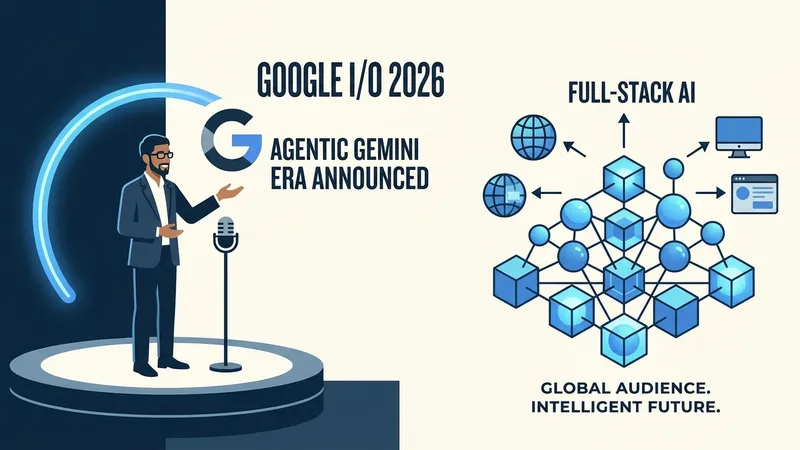
At Google I/O 2026, CEO Sundar Pichai delivered an inspiring keynote marking the dawn of the "agentic Gemini era." Following a year of relentless shipping, technological breakthroughs, and hyper-progress, the AI cycle has reached a pivotal phase where users demand tangible value in their daily lives—a demand Google is meeting head-on with today's announcements.
Ten years after pivoting to an AI-first company, Google continues to see AI as the most profound vehicle for advancing its mission. Google's advantage lies in its differentiated, full-stack approach to AI innovation, spanning custom silicon (TPUs), secure infrastructure, world-class foundation models, and global product platforms. This vertical integration allows Google to iterate and innovate at an unprecedented pace.
The real-world impact is evident in how people engage with Gemini, from students prep-studying for exams, to creators leveraging specialized models like Lyria and Veo, to millions of developers coding and bringing complex ideas to life.
To quantify this massive adoption, Google highlights its explosive token growth: two years ago, Google processed 9.7 trillion tokens monthly; last year, that grew to 480 trillion; and today, it has surged over 7x to a staggering 3.2 quadrillion tokens per month. This monumental scale reflects how deeply developers and enterprises are building with Google, with over 8.5 million developers now utilizing the platform.
[AgentUpdate Depth Analysis] Google’s I/O 2026 keynote signals a decisive paradigm shift from conversational assistants to proactive AI Agents. The 7x surge in monthly token processing to 3.2 quadrillion demonstrates that Agent workflows—characterized by multi-step reasoning, tool-use, and continuous feedback loops—are consuming massive, sustained compute scale. By vertically integrating its TPU infrastructure, advanced multimodal models (Gemini, Veo, Lyria), and high-distribution consumer endpoints, Google is building an impregnable moat for the Agentic era. This transition shifts the competitive landscape of AI from standalone LLM benchmarks to a full-stack execution war, where the winners will be determined by who can orchestrate low-latency, cost-effective, and highly contextual Agent systems at global scale.