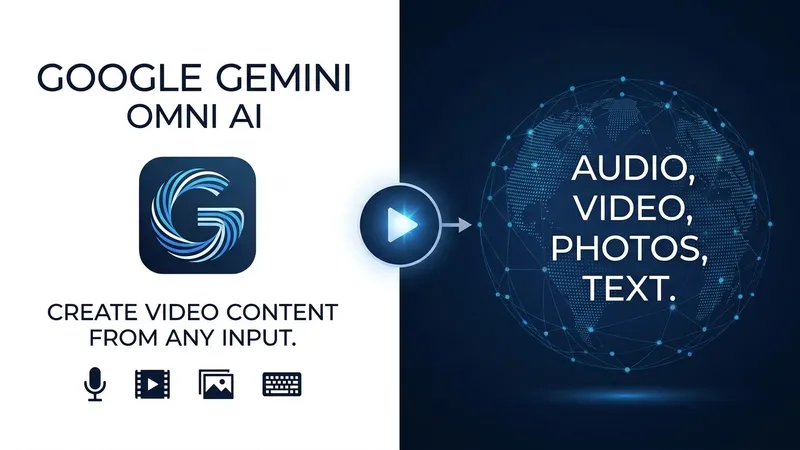
Google has introduced its new Gemini Omni artificial intelligence (AI) model, aiming to revolutionize multi-modal content creation. The model's core promise is to "create anything from any input," encompassing audio, video, photos, and text. Initially, Gemini Omni focuses on video generation, which users can then edit via conversational text with Gemini. This first iteration, Gemini Omni Flash, is now available in the Gemini app, Google Flow, and YouTube Shorts.
According to Google, editing AI-generated video using text is straightforward. The model also ensures consistency after editing, including character appearance, and Omni can remember what was visible in previous scenes. Google states that Gemini Omni can leverage its "intuitive understanding of physics," effectively "bridging the gap from photorealism to meaningful storytelling."
Users have already achieved impressive results with Gemini Omni. For instance, former Google product manager Bilawal Sidhu provided Gemini Omni with a photo containing a sketched drone path, and the AI successfully generated drone POV footage.
Allison Johnson of The Verge described Omni as "wild" in her review, using the AI to bring her child's stuffed animal, Buddy, to life for AI-generated adventures like white-water rafting and snowboarding. Johnson noted: "The results are such a mixed bag they’re baffling. Some were very good — much more consistent and true to my prompt than when I was testing out Veo five months ago. But even the best clips Omni cooked up for me still have certain AI jump scares, like when Buddy suddenly switches orientation while he’s skydiving."
Johnson's tests also highlighted Omni's most significant claim to fame—its ability to combine a wide variety of input media with AI-generated video. This capability is technologically impressive but also poses potential hazards. One of her deepfakes even convinced her husband, who has seen her almost every day for the past decade.
Whether this capability is innovative or alarming elicits varied opinions. A Threads user, near_photography, responded to Johnson's post by stating: "I can’t be the only one to think, that this just has no reason to exist. There is no net benefit to society from this capability." This reflects ongoing industry concerns regarding the authenticity, ethics, and potential misuse of AI-generated content.
[AgentUpdate Depth Analysis]
Google's launch of Gemini Omni, particularly its multi-modal input and conversational text-based video editing capabilities, marks a significant leap for the AI Agent ecosystem in terms of perception and generation. Compared to other leading text-to-video models like OpenAI's Sora, RunwayML, and Pika Labs, Gemini Omni's unique selling point lies in its emphasis on generating content "from any input" and tightly integrating video generation with subsequent text-driven editing. This implies that AI Agents are no longer confined to single modalities but can now act more like humans, receiving instructions through various senses and executing complex tasks with multi-modal outputs. For example, a design Agent could receive client input and generate proposals, iterating based on textual feedback. Its claimed "intuitive understanding of physics" is a crucial step towards general-purpose AI Agents, providing higher fidelity simulation capabilities.
However, this capability brings profound implications and potential challenges. It vastly expands Agent potential in creative industries, education, and simulation, enabling them to undertake more concrete and complex tasks. On the other hand, deepfake ethical and security concerns reach new heights. When AI Agents can generate deceptive video content, ensuring authenticity, traceability, and preventing malicious use becomes paramount for Agent security. Future AI Agents will require robust built-in content verification and ethical constraint modules. Gemini Omni accelerates the evolution of AI Agents from information processors to multi-modal content creators, while also demanding stricter regulatory and technical responses.