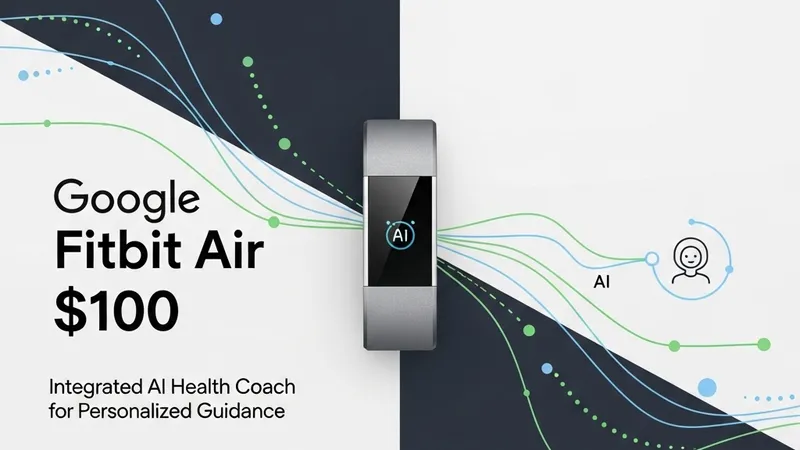
Google has officially launched its latest wearable device, the Fitbit Air, priced at an accessible $100. This new offering integrates an advanced AI health coach, signaling Google's aggressive strategy in the smart health tracking sector, directly challenging premium subscription-based services like Whoop.
The Fitbit Air's central innovation is its embedded AI health coach. This feature leverages machine learning algorithms to analyze user data, including heart rate, sleep patterns, activity levels, and other key health metrics. Beyond providing real-time feedback, the AI coach utilizes long-term data trends to deliver personalized workout recommendations, recovery guidance, and sleep optimization strategies. Unlike traditional trackers that primarily display data, the Fitbit Air's AI aims to offer actionable insights and proactive interventions, empowering users to better understand and improve their health.
Market-wise, the Fitbit Air is positioned to directly compete with products like Whoop, which emphasize athletic recovery and in-depth health analytics. However, Fitbit Air's $100 price point significantly lowers the barrier to entry for AI-driven health tracking. In contrast to Whoop's model, which typically involves a subscription bundled with a higher-priced device, the Fitbit Air is expected to attract a broader consumer base, especially those seeking a high-value, intelligent health solution. Furthermore, leveraging Google's robust ecosystem, Fitbit Air holds potential advantages in data integration and overall user experience.
Industry analysts suggest that the introduction of Fitbit Air could redefine the value proposition for mainstream wearable health devices. By democratizing AI coaching functionalities to an mass-market price point, Google not only expands its footprint in health tech but may also compel existing premium players to re-evaluate their pricing strategies and feature differentiation, thereby fostering the industry's evolution towards more intelligent and inclusive health solutions.