The Tonga Trench, located northeast of New Zealand, is deeper at its deepest than Mount Everest is tall, making it the second-deepest ocean trench on Earth. Withstanding ambient pressures of roughly 15,000 pounds per square inch at its depth, this extreme environment is surrounded by an eerie formation known as the abyssal plain.
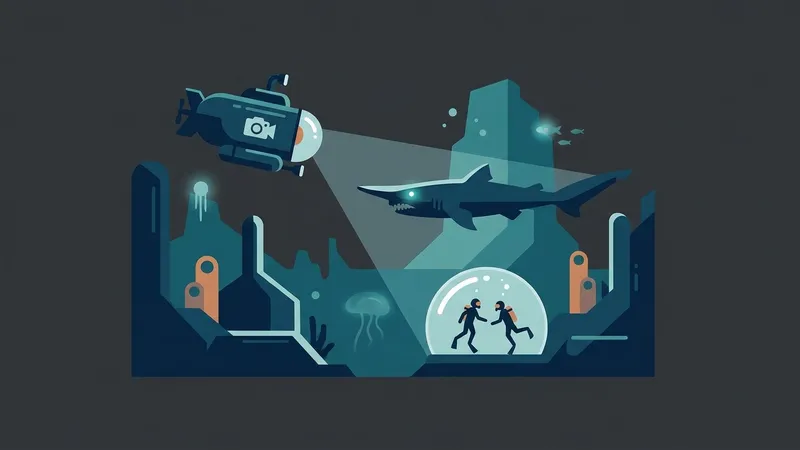
It is in this inhospitable realm that the ancient Goblin Shark resides. In May, marine biologist Alan Jamieson, director of the Minderoo-UWA Deep-Sea Research Centre, and his colleagues reported capturing the first-ever footage of this elusive species swimming in its natural habitat. This discovery dramatically rewrites marine science, expanding the shark's known territorial waters and extending its known habitat depth by thousands of feet.
The team documented two verified encounters of the living shark: one captured in 2019 northwest of Jarvis Island at 1,237 meters (4,058 feet) below sea level, and another in 2024 at an astonishing 1,997 meters (6,552 feet) deep within the Tonga Trench. Previously, the species had only been observed alive as accidental bycatch, dying as they were dragged to the surface.
Often referred to as a "living fossil," the goblin shark is the sole survivor of the ancient Mitsukurinidae family. It possesses highly specialized, protrudible jaws capable of snatching and crushing prey in the dark. Before this research, goblin sharks were only documented near Japan, Australia, the US West Coast, and small pockets of the Atlantic and Indian Oceans. This discovery officially extends the maximum known depth range of lamniform sharks by 108 meters (354 feet).
[AgentUpdate Depth Analysis] The successful capture of this rare creature in extreme deep-sea conditions highlights not just a marine biology milestone, but a prime proving ground for Embodied AI and autonomous deep-sea agents. Under crushing pressure, complete darkness, and near-zero connectivity, traditional remote-controlled systems fail. This necessitates the deployment of resilient Edge-AI Agents embedded in deep-sea landers and Autonomous Underwater Vehicles (AUVs). Looking ahead, autonomous agents operating lightweight multimodal models will transition from passive recording instruments to active explorers—independently detecting biological anomalies, optimizing paths, and coordinating Multi-Agent systems to monitor elusive species. This technological leap will revolutionize how we explore Earth's last frontiers and eventual extraterrestrial oceans.