Directed by the legendary Steven Spielberg, the new sci-fi film Disclosure Day has landed in theaters, promising a narrative about alien visitation and grand revelation. However, the film has sparked a deeper, unexpected dialogue within the tech community regarding the nature of universal communication and intelligence.
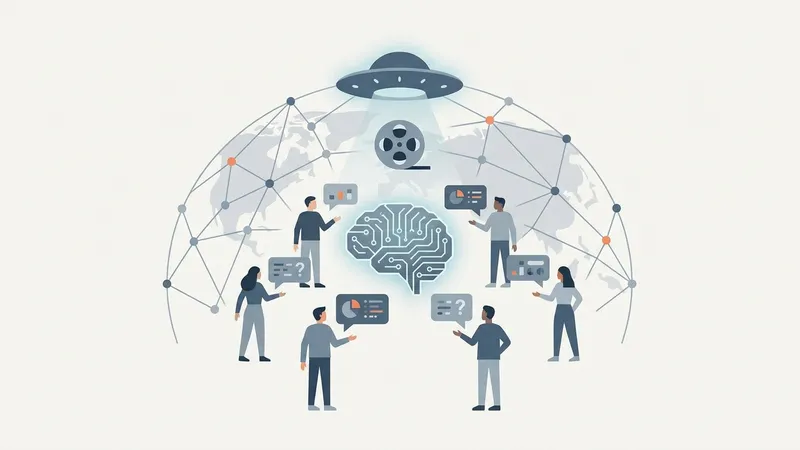
As the plot unfolds, we learn that Daniel and Margaret possess superhuman abilities: Daniel can decode the universal language of mathematics, enabling physical-logical communication, while Margaret can read deep human emotions, facilitating profound empathy. This dual-core framework directly mirrors the ideal state of next-generation AI Agents, which rely on a combination of symbolic reasoning (logic) and affective computing (empathy) to function.
During the thrilling climax at a Kansas City news station, Daniel uploads classified Wardex files to broadcast undeniable proof of extraterrestrial life, showcasing intense sci-fi spectacle. In the final moments, an escaped alien whispers a message to Daniel, who translates it for Margaret to broadcast to the world.
Standing before the live camera, fully embracing her destiny, Margaret delivers only a single word before the screen cuts to black: "Listen."
[AgentUpdate Depth Analysis] The conceptual core of *Disclosure Day* serves as a profound allegory for the evolving AI Agent landscape. Daniel’s mathematical synthesis represents structured, logical data exchange—akin to the newly proposed Model Context Protocol (#MCP)—while Margaret’s emotional intuition represents the pinnacle of human-AI alignment. As the tech world pushes toward advanced multi-agent systems, the climactic command to "Listen" acts as a warning for modern AI developers. In our rush to build agents that execute actions and generate endless output, we must not overlook the critical infrastructure required for agents to truly "listen"—interpreting nuanced human intent and collaborating seamlessly across diverse environments. The true challenge of #AGI lies not in computational scale, but in building these adaptive, bi-directional channels of understanding.