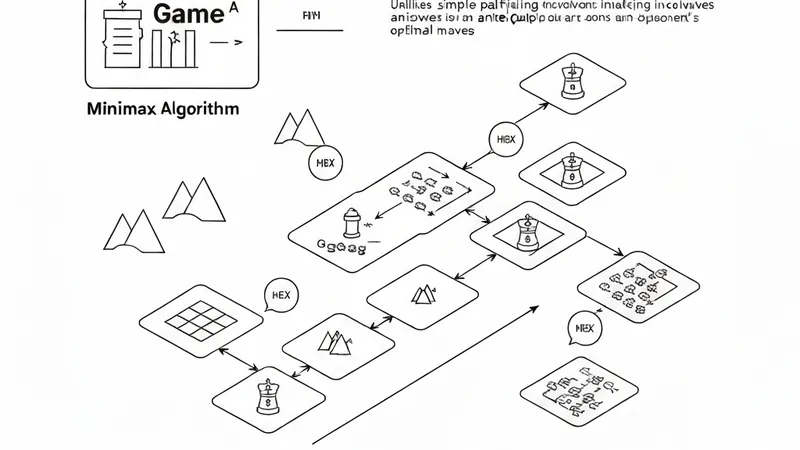
Game Artificial Intelligence (AI) decision-making significantly differs from ordinary search problems. Instead of merely finding a path, #Game AI must make strategic moves while an opponent actively tries to block or counter them. This adversarial nature necessitates a distinct decision-making structure.
The core idea behind the #Minimax algorithm is rooted in the fact that every move in a game search creates a new state. However, unlike simple pathfinding, the subsequent state is not entirely under the player's control, as the opponent also makes choices. Thus, the algorithm must answer a crucial question: "What is my best move if the opponent also plays optimally?" This question forms the heart of Minimax.
A typical game decision flow involves: Current Board → Possible Moves → Opponent Responses → Score Positions → Choose Best Move. Minimax formalizes this concept:
- The MAX player aims to maximize the score.
- The MIN player aims to minimize the score.
- The final decision assumes both players play optimally.
Therefore, Game AI is not just about selecting a seemingly good move; it's about choosing a move that can withstand the opponent's best possible response.
From an implementation perspective, Minimax operates as a recursive search problem. The high-level pseudocode illustrates its mechanism:
function minimax(state, depth, maximizing_player):
    if state is terminal or depth is 0:
        return evaluate(state)

    if maximizing_player:
        best_score = -infinity

        for each possible move:
            score = minimax(next_state, depth - 1, false)
            best_score = max(best_score, score)

        return best_score

    else:
        best_score = +infinity

        for each possible move:
            score = minimax(next_state, depth - 1, true)
            best_score = min(best_score, score)

        return best_score
This recursive structure effectively translates opponent-aware decision-making into a solvable search problem, highlighting Minimax's utility in strategic game scenarios.
Consider a simple board game where you have three possible moves: A, B, and C. A naive AI might select Move A because its immediate board score appears highest. However, Minimax asks a deeper question: "What can the opponent do after I choose Move A?" If Move A allows the opponent to win on their next turn, it's not actually a good move. Minimax avoids such pitfalls by looking ahead and considering future states.
The key differences between a naive choice and Minimax are stark:
- Naive Choice: Evaluates only the current move; ignores the opponent’s best response; prone to obvious traps.
- Minimax: Evaluates future states; assumes the opponent plays optimally; selects the move with the best worst-case outcome.
Thus, Minimax is not simply about picking the move with the highest score. It is about choosing the move whose worst-case result, assuming optimal play from the opponent, is still the best among all options. This defines its core principle.
While small games might allow for searching all the way to the end, real-world game trees quickly become prohibitively large. Exhaustive evaluation of every possible future is impossible. Therefore, the search is typically stopped at a limited depth, and the position is estimated using a heuristic function. This estimate is crucial for practical Minimax implementations.