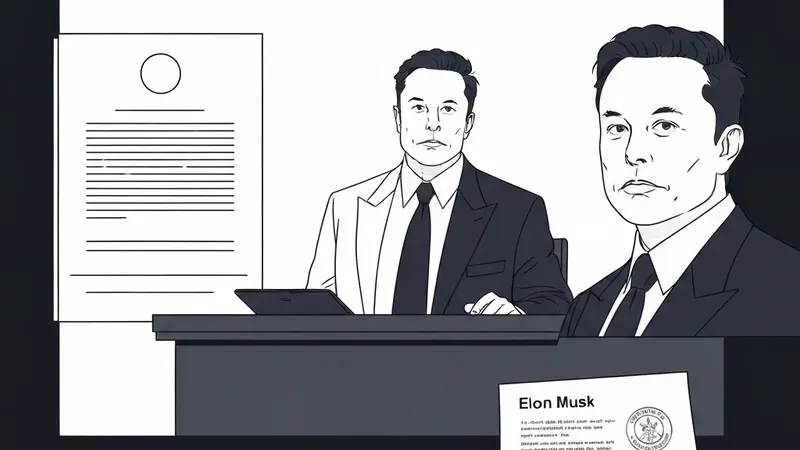
Elon Musk, during his lawsuit against #OpenAI, publicly admitted in court that xAI's #Grok model had partially 'distilled' OpenAI's models, specifically ChatGPT. This revelation occurred during a federal court hearing in Oakland, California, drawing significant attention.
On the fourth day of the trial, April 30th, OpenAI's lead counsel, William Savitt, directly asked Musk if xAI had distilled OpenAI's models. Musk initially responded that “all AI companies are doing this” before conceding that Grok had done so “partly.” This admission quickly sparked controversy across the tech and legal communities, given that Musk is the plaintiff in the lawsuit, accusing OpenAI of 'betraying its non-profit mission.'
Model 'distillation' is a common practice in AI, where a smaller, more efficient 'student' model is trained to mimic the performance of a larger, more complex 'teacher' model, often at a lower cost. While the legality of such practices remains a gray area, it likely violates OpenAI's terms of service. Musk’s lawsuit alleges that OpenAI and its CEO, Sam Altman, diverted the original non-profit mission into an $800 billion for-profit entity, creating an ironic contrast with his current actions.
Another notable detail from the trial was Musk's ranking of global AI companies. When questioned about his previous boasts that xAI would surpass all companies except Google, Musk's in-court ranking placed Anthropic first, OpenAI second, Google third, open-source models fourth, and xAI last. He described xAI as “very small, about a tenth the size of OpenAI.” This humble stance contrasted sharply with his usual public pronouncements on X (formerly Twitter) and is perceived as a legal strategy to counter allegations that his lawsuit is intended to stifle competition.
Judge Yvonne Gonzalez Rogers also played a pivotal role. When Musk's lawyers attempted to introduce discussions about AI potentially leading to 'human extinction,' the judge promptly intervened. She noted that despite Musk's frequent mentions of AI risks, he was actively building an AI company and distilling competitor models, asserting that this was irrelevant to the core legal question of whether a charitable trust had been breached. This intervention effectively prevented the trial from veering into speculative AI doomsday scenarios.
A critical witness for the case is OpenAI co-founder Greg Brockman, who is scheduled to testify next week. His private diary entries have been admitted as evidence by the court, with passages implying a lack of transparency with Musk regarding OpenAI's pivot to a for-profit structure and an intent to proceed 'without him.' These diary entries are central to the judge's decision to send the case to a jury trial, although OpenAI claims Musk's legal team has taken them 'out of context.'
The four-day trial has brought to light numerous profound issues within the Silicon Valley AI industry. Musk's admission of distillation exposed a common industry practice; his in-court ranking of AI companies and self-deprecation served as a litigation tactic; and the judge's interventions refocused the trial on core legal principles. With Brockman's testimony on the horizon, this legal drama concerning the future direction and ethical boundaries of AI is expected to reach its climax.