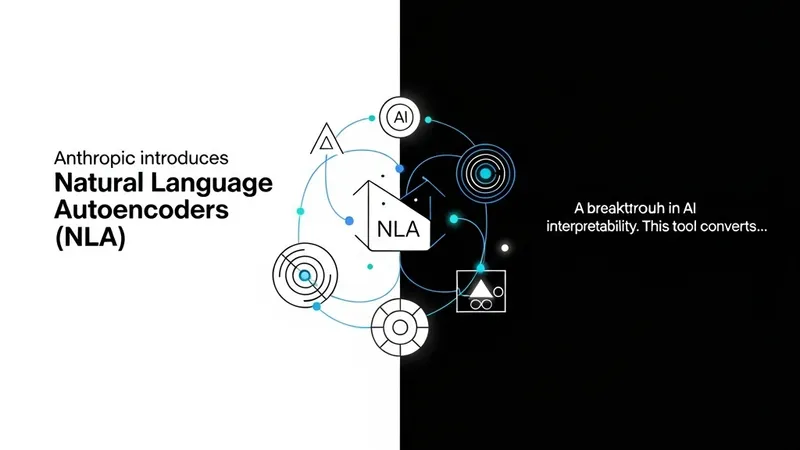
Anthropic is pushing the boundaries of AI interpretability with the development of Natural Language Autoencoders (NLA). This innovative approach allows Large Language Models (LLMs) to literally explain their own internal thought processes in plain English, transforming how researchers interact with neural networks.
Historically, deciphering the logic behind a model's output required analyzing dense numerical datasets or performing labor-intensive manual inspections. NLA shifts this paradigm by translating complex activations within the model's residual stream into readable bullet points. This allows researchers to understand the specific concepts and reasoning patterns the model utilizes during inference without relying on sprawling diagrams.
A key advantage of NLA over traditional methods, such as static probes or manual attribution graphs, is its ability to provide dynamic, real-time feedback. The technology is specifically designed to interpret the internal states of models like Claude Opus 4.6 during active processing. This makes model alignment and debugging significantly more intuitive, as engineers can see exactly why a model arrives at a certain conclusion.
By teaching LLM concepts to "speak" in human language, Anthropic is effectively opening the AI "black box." This breakthrough represents a major leap forward for researchers aiming to ensure AI systems are safe, aligned, and transparent, moving from complex mathematical visualization to direct conceptual communication.