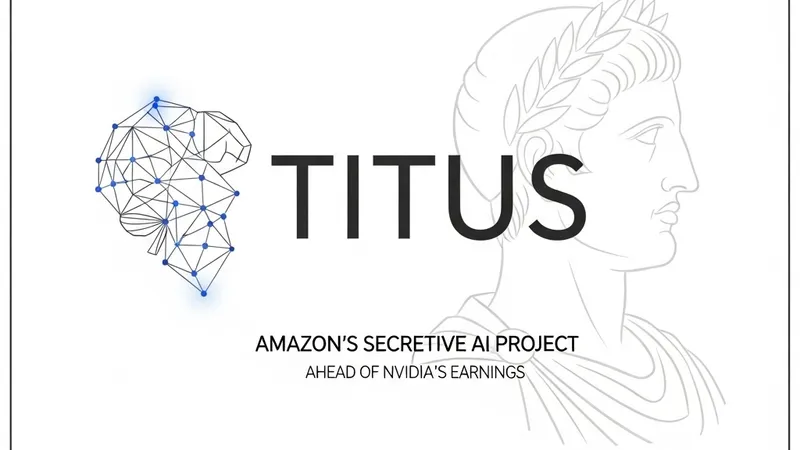
Ahead of Nvidia's highly anticipated earnings report later this week, a secretive Amazon AI project codenamed "Titus" has come to light. This project reveals the true extent of Nvidia's influence over the tech industry's infrastructure roadmap.
Amazon states the project is named after Roman Emperor Titus Flavius Vespasianus, famous for completing the Colosseum—one of history's earliest examples of massive modular architecture. The Colosseum’s repeating, self-supporting arches allowed for rapid construction and a scalable design. Amazon aims to apply these exact concepts to its next-generation AI data centers to handle the unprecedented demands of modern computing.
While the official explanation focuses on architectural efficiency, the name "Titus" carries a deeper resonance. Much like the Shakespearean general, the project highlights a complex struggle for dominance. Despite Amazon's aggressive push for its custom-designed Trainium AI chips, Project Titus underscores the reality that Nvidia’s GPUs remain the indispensable gold standard for high-end AI training.
Amazon's goal with this modular approach is to accelerate the build-out of its AI infrastructure. However, the engineering requirements for training large language models (LLMs)—specifically regarding interconnect bandwidth and power density—mean that Nvidia's technology, such as the Blackwell GB200 systems, remains the central pillar around which these data centers are designed. This reinforces the notion that Nvidia is not just a component supplier, but the architect defining the modern AI landscape.