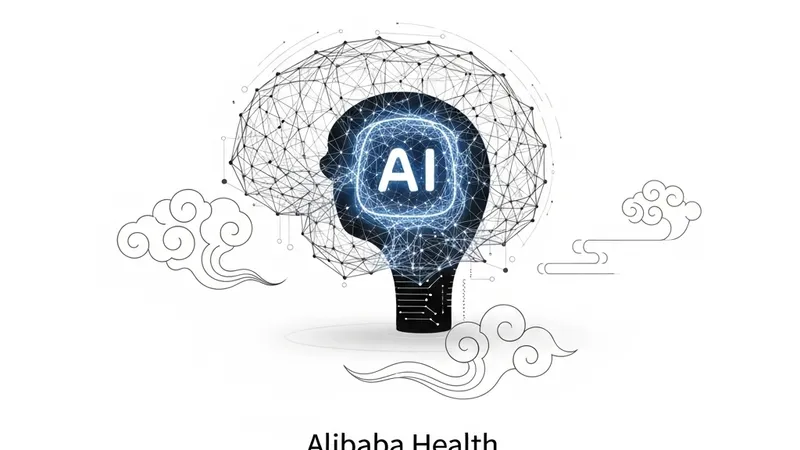
In the high-stakes healthcare industry, the "hallucination" of general-purpose LLMs remains a critical obstacle. To address this, Alibaba Health has officially launched "Hydrogen Ion," a new medical AI assistant designed specifically for China's 5 million doctors. Instead of general-purpose conversational AI, Hydrogen Ion focuses on addressing clinical pain points such as slow evidence retrieval, literature search bottlenecks, and fragmented tool switching, ensuring that every AI-generated clinical statement is fully traceable.
Currently, over half of Chinese clinicians must juggle multiple apps to check drug databases, search guidelines, or translate English literature. Hydrogen Ion unifies these tasks. Through its evidence-based Q&A feature, the system parses natural language, voice, or medical charts, and links every assertion directly to specific paragraphs in guidelines or literature. Clinicians can click on citations to inspect the source research design (such as RCTs or real-world studies) to maintain ultimate control over clinical decisions.
To secure authoritative evidence, Alibaba Health announced an exclusive partnership with the BMJ Group, a world-leading medical publisher. Hydrogen Ion will be the sole platform in China providing direct access to a decade's worth of literature and multimedia across BMJ's 70 prestigious journals. This is supplemented by existing partnerships with domestic authorities like the Chinese Medical Association and the People's Medical Publishing House. Additionally, the system compresses SCI literature reading and synthesis from up to two hours down to under five minutes, complete with professional translation tools.
Under the hood, Hydrogen Ion rejects the "probabilistic text prediction" of generic LLMs, introducing a four-layer Evidence-Based AI Architecture. Layer 1 (Evidence Understanding) parses papers using the PICO framework and GRADE standards to evaluate evidence strength. Layer 2 (Precision Retrieval) employs PICO semantic matching to link complex clinical scenarios with highly relevant evidence. Layer 3 (Fine-tuning & RL) trains the model to strictly synthesize within evidence boundaries without overstepping into making independent clinical decisions. Layer 4 (Expert Evaluation) establishes a medical AI expert committee with over 300 clinical experts to continuously validate the dataset and benchmarks.
[AgentUpdate Depth Analysis] Alibaba Health's "Hydrogen Ion" represents a significant evolution in vertical-specific AI Agents, particularly in zero-tolerance fields like healthcare. Unlike general-purpose RAG-based agents, Hydrogen Ion's core innovation lies in embedding industry-specific cognitive frameworks (such as PICO and GRADE) directly into the agent's multi-layered retrieval and reasoning pipelines. This "framework-constrained Agent" approach goes beyond simple prompt engineering to digitally reconstruct rigorous professional workflows. While models like Google's Med-PaLM focus on end-to-end medical reasoning, Hydrogen Ion prioritizes a verifiable productivity tool through exclusive high-quality data integration (BMJ) and a structured architecture. It demonstrates that the future of vertical Agents depends on moving away from black-box probabilistic outputs to white-box systems anchored in robust evidence chains, workflow alignment, and human-in-the-loop validation, offering profound implications for the broader Agent ecosystem.