Introduction
When building autonomous AI agents, developers often run into a common bottleneck: the LLM's sensory isolation from the physical world and real-time data. No matter how powerful the model is (such as Claude 3.5 Sonnet or GPT-4o), without "sensory organs" to read inputs and "hands" to execute actions, it remains an isolated brain in a sandbox.
To solve this, the open-source community and AI ecosystem have contributed excellent Agent-enhancement toolkits. Three projects have gained significant traction in their respective niches:
- Agent-Reach (by Panniantong): A zero-configuration, zero-API-cost social network and search engine connector for local developer environments.
- Firecrawl (by Mendable.ai): An enterprise-ready web crawler that converts any URL into clean, LLM-ready Markdown.
- Composio: A workflow execution engine providing 1000+ SaaS applications with managed OAuth authentication.
A frequent question is: Are these tools competing? Which one should I choose?
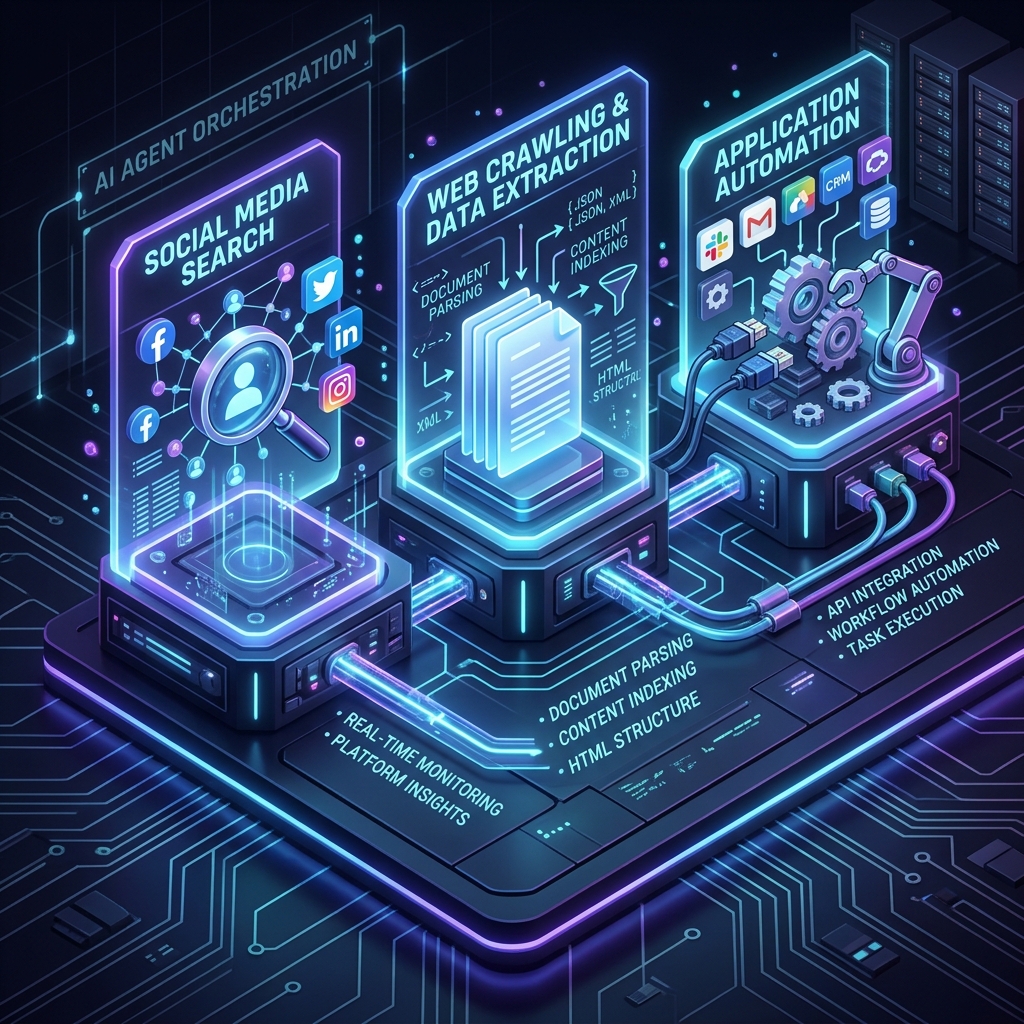
In fact, they serve entirely different layers of the Agent stack: "Lightweight Social Search," "Structured Web Scraping," and "Application Actions." In this guide, we break down their architectures, differences, and how to combine them into a unified agent workflow.
Core Concepts & Architectures
1. Agent-Reach: Zero-Cost Social and Search Connector for CLI Agents
- GitHub: https://github.com/Panniantong/agent-reach
- The Problem: Major social media and community networks (like X/Twitter, Reddit, Bilibili, Xiaohongshu, Weibo) either charge exorbitant API fees, enforce complex developer approvals, or maintain aggressive anti-bot walls.
- How it Works:
Agent-Reach is a lightweight skill scaffolding designed specifically for CLI-based coding agents (such as Claude Code, Cursor, and Windsurf). Under the hood, it utilizes a "Local Mediation & Spoofing" mechanism:
- It bundles local scraper scripts and headless CLI binaries (e.g.,
yt-dlpand customized platform-specific renderers). - It wraps them in a unified CLI command:
agent-reach query <platform> <keyword>. - It provides a diagnostic command
agent-reach doctorto test local network accessibility. - The Killer Feature: It runs 100% locally and requires zero third-party API registration or credit cards, routing social searches through optimized local wrappers for free.
- It bundles local scraper scripts and headless CLI binaries (e.g.,
2. Firecrawl: Web Crawler & Markdown Converter for LLM Contexts
- GitHub: https://github.com/firecrawl/firecrawl
- The Problem: Web pages are littered with dynamic JavaScript, cookie popups, ads, navigation menus, and redundant headers/footers. Feeding raw HTML into LLMs wastes massive tokens and injects noisy contexts.
- How it Works:
Firecrawl is a robust crawling and scraping gateway built specifically for Retrieval-Augmented Generation (RAG) pipelines:
- It operates a distributed pool of headless browsers (Playwright/Puppeteer).
- It manages proxy rotation, CAPTCHA bypasses, and performs page interactions (scrolling, clicking, waiting).
- Its parser algorithm strips out wrappers, advertisements, and menus, translating the core semantic content into clean, structured Markdown while preserving markdown links.
- It features single-page scraping (
/scrape), sitemap mapping (/map), and site crawling (/crawl).
3. Composio: SaaS Integration & Action Workspace
- GitHub: https://github.com/composiohq/composio
- The Problem: Information retrieval is only half the battle. When an Agent needs to open a pull request on GitHub, update a ticket in Jira, schedule a Google Calendar meeting, or post to Slack, developers must manage diverse APIs, rate limits, and secure OAuth credentials.
- How it Works:
Composio provides the infrastructure for AI Agent execution:
- It hosts a managed OAuth authentication gateway, handling callback setups, token refreshes, and encryption.
- It features integrations with 1000+ SaaS applications, converting OpenAPI/Swagger specifications into standard LLM Tool Calling schemas automatically.
- It offers sandboxed runtime environments (Sandbox Tooling) where agents can safely execute Python scripts or shell commands to process data locally.
Comparison Matrix
| Dimension | Agent-Reach | Firecrawl | Composio |
|---|---|---|---|
| Core Value | Zero-cost social media search and text fetching for CLI agents | High-reliability general web scraping to LLM markdown | Managed SaaS API actions and OAuth credentials |
| Data Targets | Social networks (X, Reddit, Xiaohongshu, Bilibili, YouTube, Weibo) | Any public website, dynamic SPAs, or PDF documents | Cloud applications (GitHub, Slack, Jira, Gmail, Notion) |
| Deployment | Installed locally via npm/git, running as a CLI utility | Self-hosted backend server (Docker) or Cloud SaaS API | Hybrid (Local SDK + Cloud-managed Auth portal) |
| API Keys | None required. Bypasses paid API registration | Required (Free tier/Paid cloud plan, or free self-hosted) | Required (Composio dashboard credentials) |
| Primary Output | Plain text / JSON search snippets and posts | Token-optimized, stripped Markdown documents | API execution status and returned payloads |
| MCP Support | Runs as local commands, easily wrapped as an MCP | Native Model Context Protocol (MCP) server support | Native MCP support to expose SaaS integrations |
Combined Workflow Topology
In production systems, these tools do not compete; they compose.
Here is the architecture of an Automated Market Intelligence Agent:
flowchart TD
    subgraph Engine ["AI Agent Decision Center (e.g. Claude 3.5 Sonnet)"]
        LLM["Large Language Model"]
    end

    subgraph Phase1 ["Phase 1: Trend Discovery"]
        AR["Agent-Reach CLI"]
        Social["Social Platforms (X/Twitter, Reddit, YouTube)"]
        AR -->|Local Scrapes| Social
    end

    subgraph Phase2 ["Phase 2: Deep Reading"]
        FC["Firecrawl API (RAG)"]
        Docs["Competitor Documentation / Dynamic Web Pages"]
        FC -->|Headless Render & Markdown Clean| Docs
    end

    subgraph Phase3 ["Phase 3: Execution (Actions)"]
        CP["Composio App Actions"]
        Notion["Notion Database"]
        Slack["Slack Channels"]
        GitHub["GitHub Repository"]
        CP -->|OAuth Connections| Notion
        CP -->|OAuth Connections| Slack
        CP -->|OAuth Connections| GitHub
    end

    LLM -->|1. Query Tech Trends| AR
    Social -->|Return Snippets & Links| LLM
    LLM -->|2. Scrape Detailed Docs| FC
    Docs -->|Return Clean Markdown| LLM
    LLM -->|3. Generate Report & Deploy| CP
    CP -->|Archive & Alert Team| Notion
    CP -->|Archive & Alert Team| Slack
    CP -->|Archive & Alert Team| GitHub
Integration Code Snippet (Node.js)
Here is how you can use all three tools in a single script:
import { execSync } from 'child_process';
import { FirecrawlApp } from '@mendable/firecrawl-js';
import { ComposioToolSet } from 'composio-core';

// 1. Initialize Firecrawl
const firecrawl = new FirecrawlApp({ apiKey: process.env.FIRECRAWL_API_KEY });

// 2. Initialize Composio
const composio = new ComposioToolSet({ apiKey: process.env.COMPOSIO_API_KEY });

async function runAutonomousWorkflow() {
  console.log("🚀 Starting Agent workflow...");

  // ====== Step 1: Use Agent-Reach to search social trends for free ======
  console.log("\n[1] Querying Twitter/Reddit trends via Agent-Reach...");
  const reachResult = execSync("agent-reach query reddit 'Agentic workflows'", { encoding: 'utf-8' });
  console.log("Agent-Reach query successful.");

  // Regex extract a target URL from social posts
  const targetDocUrl = "https://example-ai-docs.com/agent-design.html";

  // ====== Step 2: Use Firecrawl to crawl and clean the web page ======
  console.log(`\n[2] Crawling and cleaning: ${targetDocUrl}`);
  const scrapeResult = await firecrawl.scrapeUrl(targetDocUrl, {
    formats: ['markdown'],
    onlyMainContent: true
  });

  const cleanMarkdown = scrapeResult.markdown;
  console.log(`Firecrawl clean complete. Cleaned document length: ${cleanMarkdown.length}`);

  // ====== Step 3: LLM reasoning (omitted for brevity) ======
  const generatedReport = `### Agentic Trend Report\n\n**Social Summary**: ${reachResult.slice(0, 150)}\n\n**Doc Summary**:\n${cleanMarkdown.slice(0, 300)}`;

  // ====== Step 4: Use Composio to push reports to Slack and Notion ======
  console.log("\n[3] Triggering application actions via Composio...");

  // Write to Notion
  await composio.executeAction({
    action: "notion_create_page",
    input: {
      parent_database_id: process.env.NOTION_DATABASE_ID,
      properties: {
        Title: { title: [{ text: { content: "AI Agent Intelligence Report" } }] }
      },
      children: [{ object: "block", type: "paragraph", paragraph: { rich_text: [{ text: { content: generatedReport } }] } }]
    }
  });

  // Post Alert to Slack
  await composio.executeAction({
    action: "slack_post_message",
    input: {
      channel_id: "C0123456789",
      text: "📢 *AI Intelligence Report updated!* View details in Notion."
    }
  });

  console.log("🎉 Workflow execution complete!");
}

runAutonomousWorkflow().catch(console.error);
Selection Guidelines
Choose the right tool based on your Agent's functional requirements:
- Use Agent-Reach if you are running a local developer CLI (like Claude Code, Cursor, or Windsurf) and need a free, fast search connection to social media ecosystems (X/Twitter, Reddit, Bilibili, Xiaohongshu) without managing paid tokens or developer accounts.
- Use Firecrawl if your Agent performs dynamic web crawling, processes complex JavaScript applications, or needs to scrape entire documentation domains into clean Markdown files for vector databases (RAG pipelines).
- Use Composio if your Agent acts as a general-purpose executor (Action layer), requiring secure connections to SaaS dashboards (GitHub, Jira, Notion, Slack) to perform automated commits, message posting, or task tracking on behalf of users.