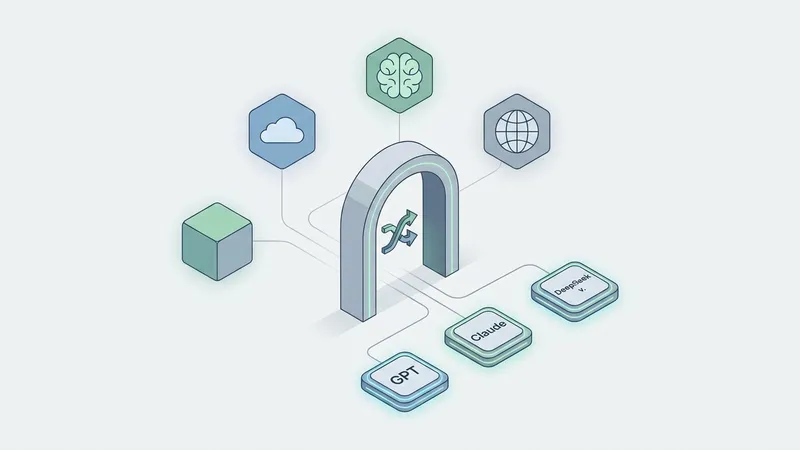
With the rapid expansion of the AI ecosystem, developers building complex applications often find themselves orchestrating multiple underlying models. For instance, leveraging GPT-4o for standard conversations, calling Claude 3.5 Sonnet for advanced coding, and utilizing the highly cost-effective DeepSeek-V3 for high-volume data processing. However, managing separate API keys, handling multiple billing accounts, and integrating disparate SDKs has become a massive bottleneck for developer velocity.
To address this friction, unified API routing solutions like OpenRouter, Portkey, and the open-source LiteLLM framework have emerged. These platforms allow developers to access dozens of leading LLMs globally through a single API key. This drastically reduces codebase complexity and eliminates the overhead of switching between different cloud providers, streamlining the entire development lifecycle.
The core technical advantage of utilizing a unified API lies in fallback resilience and load balancing. In advanced AI Agent workflows, if a primary model (such as Claude) experiences rate limiting or outages, the routing system can seamlessly redirect requests to backup models using OpenAI-compatible APIs. This dynamic failover mechanism ensures that Agent systems achieve up to 99.9% uptime.
Moreover, hybrid model architectures enable unprecedented cost optimization. Developers can route basic classification tasks to highly cost-efficient models like DeepSeek-R1, reserving expensive reasoning models only for high-complexity cognitive steps. Unified API gateways offer a single dashboard to monitor token consumption, latency, and costs across all providers, merging development and operations into one control plane.
[AgentUpdate Depth Analysis] Unified API gateways are quickly evolving into the indispensable "microservices API gateway" of the AI Agent era. As Multi-Agent systems become the dominant paradigm, agents are moving away from relying on a single "monolithic brain" to collaborative, specialized roles. In this landscape, the routing layer that dynamically dispatches tasks to the most optimal model holds strategic importance akin to modern API gateways like Kong. It addresses the two biggest challenges of enterprise Agent deployment: unpredictable costs and single points of failure. Moving forward, we expect these routing capabilities to be natively integrated into Agent frameworks like LangChain and CrewAI, enabling fully autonomous, utility-based compute allocation—a critical step for the industrialization of AI Agents.