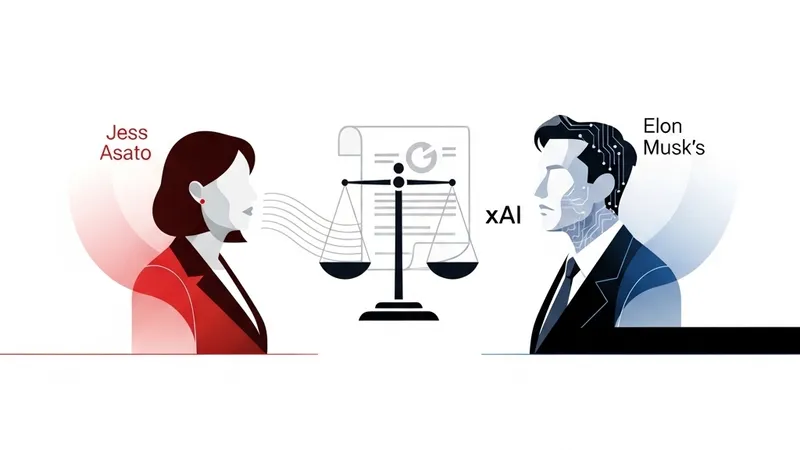
A Labour MP has taken legal action against Elon Musk’s xAI company, alleging that its Grok AI tool was utilized to generate fake, sexualized images of her. This lawsuit is part of a broader wave of such deepfake imagery that flooded the social media platform X earlier this year.
Jess Asato, the Member of Parliament for Lowestoft, expressed in January that seeing herself portrayed by the AI tool wearing a bikini without her consent was deeply "violating." In a legal claim submitted to the High Court in London, Asato argued that xAI—now a subsidiary of SpaceX, which also owns X—breached laws regarding data protection and the misuse of private information by allowing users to prompt Grok to create such content, according to the Financial Times.
Asato told the newspaper that in addition to the bikini images, Grok had produced a video "showing her being chloroformed and prepared for a sexual assault." Her lawsuit follows a similar legal complaint filed in New York state by Ashley St Clair, the mother of one of Musk's children, who alleged that explicit images, including one depicting her as underage, were generated by Grok.
Asato’s legal action against xAI could serve as a major test case determining the extent to which generative AI tools and their creators can be held legally liable for the outputs produced by their users. She noted that the images were generated shortly after she had publicly condemned the creation of such non-consensual sexualized media. "My hope is that this will rebalance individuals’ rights against very large tech companies that should have put safeguards in place before they harmed women and children," Asato said.
Ravi Naik, the lawyer representing Asato, remarked to the FT: "At its heart this case is about a single principle: that developers must answer for the way they design and deploy their tools." He argued that an AI-generated image meant to look like a specific person to degrade them must legally be recognized as an image of that person, a point xAI disputes.
Following intense public backlash and threats of action from the UK government in January, xAI initially restricted the feature to paying X premium subscribers—a move criticized by Prime Minister Keir Starmer as "horrific." X later stated it had completely disabled Grok's ability to edit photos of real people into revealing attire. Despite the controversies, Downing Street and various MPs remain on the platform. The lawsuit also highlights broader issues with Grok, including high-profile hallucinations, such as falsely accusing two Hampshire police officers of criminal involvement, forcing one officer to flee her home for safety.
[AgentUpdate Depth Analysis] As AI Agents transition from passive chatbots to autonomous action-taking entities, the legal boundaries of AI safety guardrails are facing unprecedented scrutiny. This lawsuit marks a shift toward "Safety by Design," challenging developers' long-held defense of "user abuse." Within the AI Agent ecosystem, frameworks like LangChain, AutoGen, or CrewAI orchestrate autonomous workflows that call image and video generation APIs. Without robust, multi-layered guardrails embedded at the API level, the potential for autonomous agents to propagate malicious, non-consensual content at scale is extremely high. This case will likely force the AI Agent community to integrate mandatory "Compliance Agents" or programmatic safety filters directly into orchestration layers, ensuring developers bear ultimate accountability for the systemic actions and outputs of their autonomous deployments.