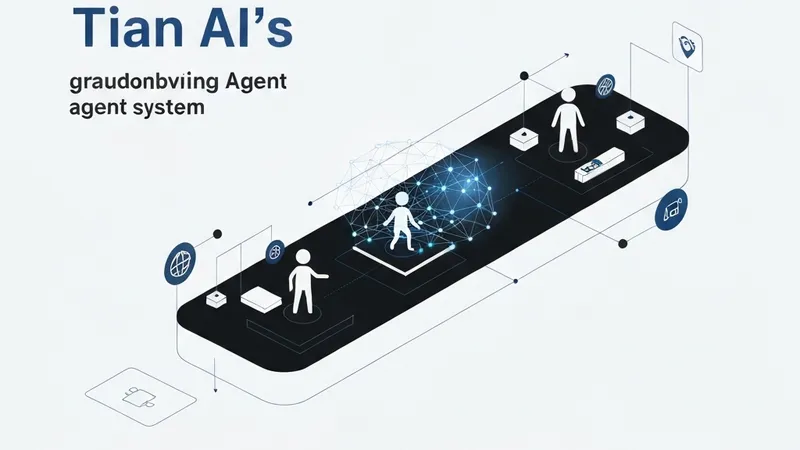
Tian AI has introduced its powerful autonomous agent system, an LLM-driven task scheduler designed to plan, execute, and adapt tasks without human intervention. This feature stands as one of Tian AI's most impactful innovations.
Traditional AI assistants are typically limited to responding to queries. Tian AI's agent system, however, proactively executes multi-step tasks, positioning it as a genuinely useful productivity tool that transcends simple reactive capabilities.
The system's robust architecture is structured as follows:
- User Request → LLM Parser for Intent Classification
- ↓
- TaskQueue for Dependency Resolution
- ↓
- Safety Whitelist for Permission Check
- ↓
- Task Execution (utilizing tools, Python, or shell commands)
- ↓
- Self-Reflection Loop
- ↓
- Outputting a Result Summary
Key Components:
LLM Parser: This component leverages Qwen2.5-1.5B to understand natural language requests and decompose them into actionable tasks. Intent categories include 'plan,' 'execute,' 'search,' 'ask,' and 'greeting.'
TaskQueue with Dependency Resolution: Tasks within the system can have interdependencies. The TaskQueue employs topological sorting to determine the correct execution order. For example:
- Task A: "Check disk space" → no dependencies
- Task B: "Backup database" → depends on A
- Task C: "Send report" → depends on A and B
Safety Whitelist: Crucial for secure autonomous execution, this whitelist defines explicit rules:
- Allowed directories (restricted to the project root only)
- Permitted shell commands (prohibiting dangerous commands like `rm -rf` or `sudo`)
- A default read-only policy; write operations require explicit permission
- Restricted network access (currently limited to dev.to and huggingface.co)
Self-Evaluation Loop: Following the execution of each task, the system initiates a self-evaluation process. It assesses:
- Whether the task completed successfully
- If the output is consistent with expectations
- Whether alternative approaches should be considered
Greeting Shortcut: To enhance efficiency, common greetings (e.g., "hi," "hello," "hey," "你好") are designed to bypass the LLM entirely, allowing for faster responses.
Example: Autonomous Workflow:
Consider a user request: "Generate a promotional video and post it to Dev.to."
- The LLM parses this into two subtasks: 'generate video' and 'publish article.'
- The TaskQueue resolves the dependency, ensuring that video generation must complete before posting.
- The Safety Whitelist permits the video generation task but blocks the posting action (as there is no write permission configured for dev.to).
- The system then reports: "I can generate the video autonomously, but posting requires your confirmation."
This meticulously designed, safety-conscious approach is what makes Tian AI a trustworthy solution for autonomous operations.