In long-horizon interactive scenarios, conversational agents must continuously adapt to evolving events, tasks, and multi-stage goals. These interaction histories are inherently temporal. However, many existing agent memory systems primarily retrieve information based on semantic similarity, largely ignoring the precise chronological order in which events occurred. This lack of temporal awareness often leads to causal confusion, severely limiting the cognitive capabilities of agents in complex, long-duration tasks.
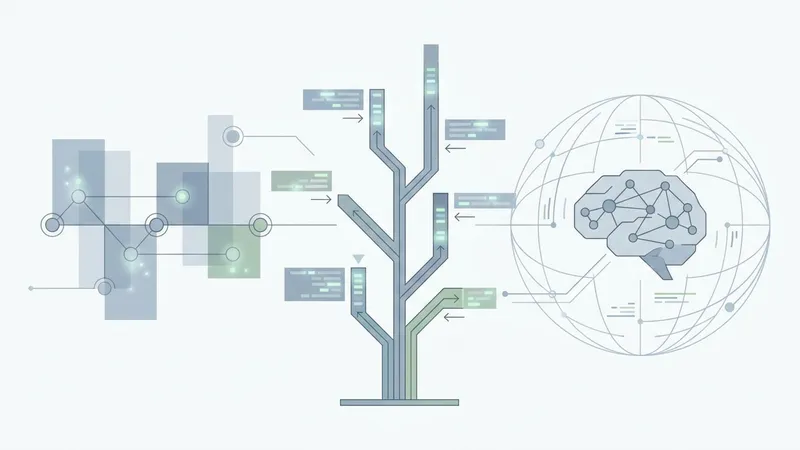
To overcome this limitation, researchers have introduced SegTreeMem (Segment Tree Memory), a novel memory architecture that represents conversation history as a temporally ordered Segment Tree over utterances. This structured design allows agents to preserve the chronological flow while organizing information into hierarchical memory segments.
During memory construction, SegTreeMem incrementally inserts new utterances using an online rightmost-frontier update rule. This approach ensures that the chronological sequence is strictly preserved while dynamically forming higher-level semantic nodes. For retrieval, rather than performing simple flat similarity searches, SegTreeMem propagates relevance scores through the tree, seamlessly blending local semantic matching with hierarchical temporal context.
Evaluation across three challenging long-horizon memory benchmarks using two different LLM backbones demonstrates that SegTreeMem consistently outperforms flat retrieval, graph-structured memories, and traditional tree-structured baselines. Furthermore, temporal-order permutation analysis verified that the performance gains are strictly tied to maintaining chronological order during memory building, validating that temporal order is a fundamental structural pillar for agentic memory.
[AgentUpdate Depth Analysis] Traditional Agent memory systems, like Vector RAG or GraphRAG, often exhibit a dogmatic reliance on semantic similarity while ignoring the unidirectional arrow of time. In complex, long-horizon interactions, state transitions and causal reasoning are fundamentally bound to chronological order. SegTreeMem elegantly addresses this by introducing the classic Segment Tree data structure to agentic memory, achieving a balanced representation of local semantics and hierarchical temporal context within an O(log N) complexity. This innovation lays a solid foundation for building autonomous agents equipped with true episodic memory and sequential reasoning. Compared to the heavy overhead of graph-based memories, this lightweight, temporally-structured approach represents a pragmatic yet profound paradigm shift, steering the future of agent memory from purely semantic matching toward spatio-temporal cognitive retrieval.