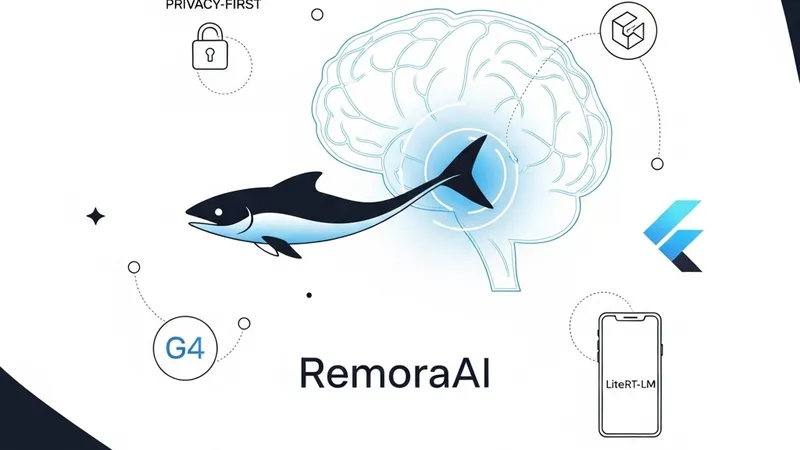
Dreams represent our most intimate thoughts. However, most AI-powered journaling applications necessitate the upload of deeply personal emotions and subconscious experiences to the cloud. RemoraAI challenges this paradigm as a privacy-first "Subconscious Social Network" powered by Gemma 4, running directly on-device using LiteRT-LM and Flutter.
The application enables users to record dreams via voice, receive AI-driven psychological interpretations, detect recurring subconscious patterns, and generate surreal dream visuals. Optionally, users can publish anonymized dreams to a community feed. The core innovation lies in the fact that sensitive psychological analysis happens entirely on-device, ensuring no raw dream data leaves the smartphone.
Historically, dream journaling has remained a private activity due to users' discomfort with uploading vulnerable content to centralized servers. RemoraAI demonstrates that modern multimodal AI can deliver meaningful emotional analysis while preserving user privacy. The workflow involves local processing of voice narratives by Gemma 4 to generate titles, emotional insights, and thematic tags, followed by optional AI-generated artwork and secure storage.
The technical stack features Flutter, LiteRT-LM, MediaPipe, and Android AI Core. The architecture is divided into three key layers: a Local AI Layer utilizing Gemma 4 E2B via LiteRT-LM for NPU-accelerated inference; a Cloud Layer for optional image generation and community features; and a Memory Layer using vector embeddings and Retrieval-Augmented Generation (RAG) for long-term subconscious pattern analysis.
Gemma 4 E2B was selected for its optimal balance of mobile performance and reasoning quality. Unlike previous models that were too large or slow for real-time mobile deployment, Gemma 4 operates efficiently on Android NPUs. This enables fully offline dream analysis, significantly reduced latency, and lower infrastructure costs, all while maximizing user privacy through local-first processing.