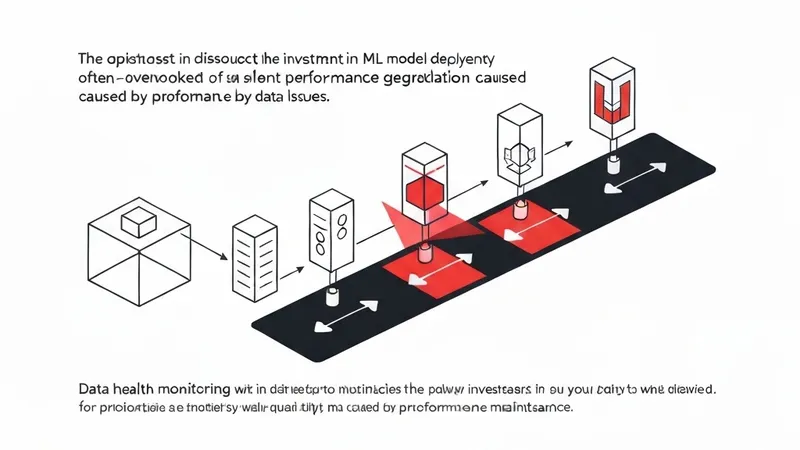
Most organizations invest heavily in building and deploying machine learning models, often celebrating the launch and tracking initial accuracy before moving on. What they rarely account for is what happens next.
The world changes. Customer behavior shifts. Data distributions drift. And silently, without a single line of code changing, your model begins to fail. “A model that was 90% accurate at launch can degrade to the point of being worse than a coin flip — and most teams won't notice for months.”
In production ML, model drift is one of the most underestimated risks. A churn prediction model trained on last year's customer data may perform brilliantly at launch, but as market conditions evolve, product offerings change, and customer demographics shift, the statistical patterns the model learned no longer reflect reality. The result? False confidence, missed churn signals, retention campaigns targeting the wrong customers, and lost revenue—not because the model was poorly built, but because nobody was watching it. Industry research suggests that most production models degrade significantly within 3–6 months of deployment, yet many teams only discover this during quarterly reviews, long after the business impact has accumulated.
Key Statistics:
- 3–6 months to significant model degradation in production.
- ~91% of companies lack real-time model monitoring.
- Millions in revenue at risk per undetected drift event.
The gap between when a model starts failing and when a team notices is where the real financial damage occurs. Compressing that window from months to days—or even hours—is not a technical nicety; it is a business imperative.
To address this critical issue, a new ML Model Monitoring & Drift Detection System has been developed. This full-stack ML monitoring dashboard provides a real-time solution, offering continuous statistical surveillance of a production Gradient Boosting Machine (GBM) model (trained on customer churn data). It flags degradation the moment it emerges, not months later. The platform monitors a live ML model across multiple time periods—from a clean T0 baseline through T1 early drift, T2 moderate drift, and T3 severe drift—giving teams a complete picture of how and when their model is degrading.
How It Works: Three Layers of Intelligence
1. Feature Drift Detection
Using three complementary statistical tests—the Kolmogorov-Smirnov (KS) test, Population Stability Index (PSI), and Jensen-Shannon Divergence (JSD)—the system detects when the distribution of input features has shifted meaningfully from the training baseline. Each feature is assigned a severity level:
- ✅ No Drift — PSI < 0.10, KS < 0.05
- ⚠️ Moderate — PSI 0.10–0.25, KS 0.05–0.15
- 🚨 Severe — PSI > 0.25, KS > 0.15