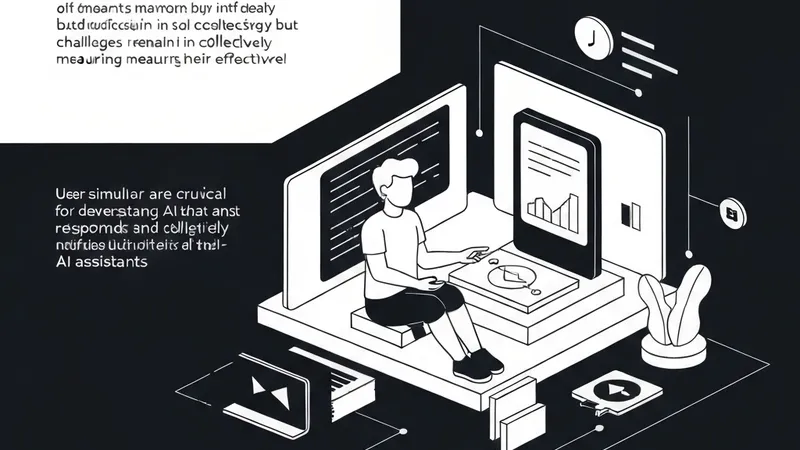
User simulators are increasingly crucial for building interactive AI assistants, especially those powered by large language models (LLMs). However, effectively measuring the quality of these simulators has remained an open challenge. Recent research proposes a novel approach to quantify simulator quality in terms of its "downstream utility": how an LLM assistant, trained with a specific user simulator, performs when interacting with real humans in practical settings.
The researchers conducted a controlled experiment where the only variable was the user simulator employed. They trained multiple LLM assistants using reinforcement learning (RL) against a spectrum of simulators. These ranged from a simple LLM prompted to role-play a user, to a more sophisticated one fine-tuned on real human utterances sourced from datasets like WildChat.
For evaluation, the team employed a two-pronged approach: a user study involving 283 participants to measure pairwise win rates, and testing on WildBench, a benchmark derived from authentic human-AI conversations. The results showed that training an assistant against a role-playing LLM simulator yielded performance statistically indistinguishable from the initial assistant in the user study, achieving a 51% win rate. In contrast, training with a fine-tuned simulator led to significant gains, with the assistant achieving a 58% win rate over the initial model and 57% over the assistant trained with the role-playing simulator.
Further analysis uncovered three critical patterns:
- Methods aimed at making role-playing LLMs more realistic (e.g., persona conditioning) did improve trained assistants but failed to close the performance gap with the fine-tuned simulator.
- Scaling the simulator's model size benefited the fine-tuned simulator but offered no discernible gain for role-playing counterparts.
- Assistants trained with role-playing simulators demonstrated poor generalization capabilities when paired with different simulators at test time, whereas the assistant trained with the fine-tuned simulator generalized effectively.
Collectively, these findings underscore the importance of grounding user simulators in real human behavior and advocating for their quality to be measured by their tangible downstream effect on actual users, rather than isolated internal metrics.