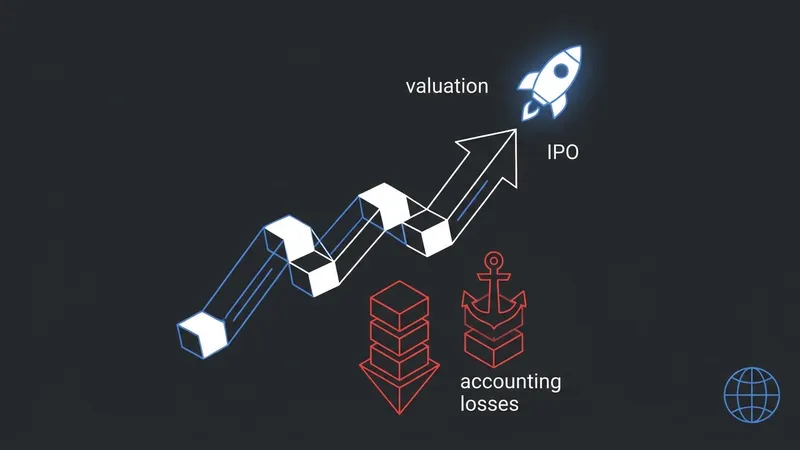
According to sources familiar with the matter, artificial intelligence giant OpenAI has seen its valuation rocket to historic highs, solidifying its position as one of the world's most valuable startups and igniting ambitious plans for an eventual IPO. Despite facing staggering accounting losses driven by massive infrastructure investments, investor enthusiasm for its commercial future remains exceptionally strong.
To pave the way for a public debut, #OpenAI is actively transitioning from its non-profit-controlled structure to a fully for-profit enterprise. This structural shift is designed to appeal to traditional public market investors. Financial projections indicate that while OpenAI's annualized revenue has surpassed $3.7 billion, its annual losses could swell to $5 billion due to heavy expenditures on Nvidia GPU clusters and cloud computing services. This high-growth, high-burn financial profile has sparked intense debate on Wall Street.
Prominent venture capital firms including Thrive Capital and SoftBank are closely monitoring the transition. Analysts suggest that a successful OpenAI #IPO would be one of the largest in tech history. It will also force the broader AI sector to seek a healthier balance between massive compute costs and real-world monetization, particularly for downstream businesses reliant on API access.
[AgentUpdate Depth Analysis] OpenAI’s soaring valuation and impending IPO march signal that the AI industry is rapidly shifting from speculative research to aggressive commercialization. For the AI Agent ecosystem, this capital-driven push is a double-edged sword. On one hand, IPO-bound pressures will compel OpenAI to aggressively monetize advanced reasoning models like GPT-4o and o1, likely driving down API costs and delivering more robust, agentic capabilities to developers. On the other hand, a highly commercialized OpenAI will inevitably guard its moat, potentially limiting open collaboration. This will accelerate the rise of independent, open-source alternatives like Llama 3 combined with agent orchestration frameworks like LangChain and CrewAI. Ultimately, the competitive moat in the Agent era will shift from raw LLM scale to domain-specific execution, real-world workflow automation, and cost-efficiency.