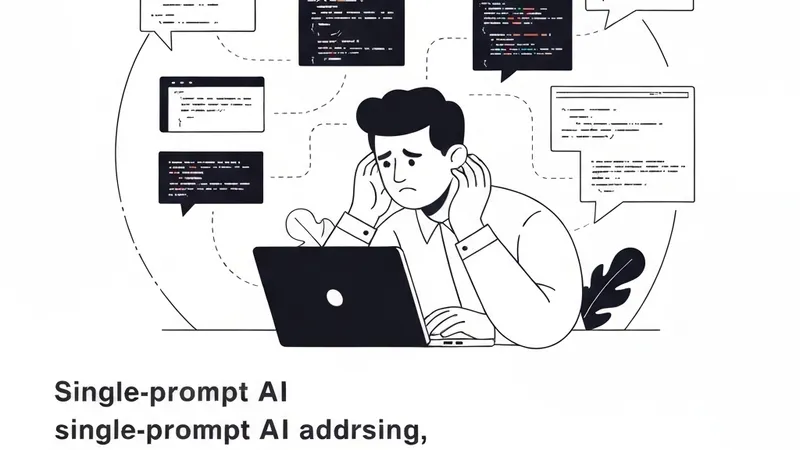
Have you ever experienced your chatbot forgetting your previous query within seconds? For complex tasks like "research these companies, compare pricing, and draft an email," you might find yourself manually copying and pasting context between messages, a tedious process reminiscent of earlier times. While AI can compose intricate poetry, it often struggles to remember step one by the time you reach step three in a multi-step workflow. This challenge represents a common wall developers encounter with single-prompt AI.
Single prompts excel at isolated tasks. However, the moment AI needs to plan, remember, and coordinate—to function as a capable assistant rather than a brilliant amnesiac—their limitations quickly become apparent.
This guide will enable you to build a working multi-agent system on your machine. In this system, specialized AI agents will autonomously hand off tasks, share context, and utilize real tools to achieve objectives without constant human oversight.
Why Single Prompts Are No Longer Sufficient
Consider explaining a billing issue to a customer service bot for the third time because it somehow forgot your account number. Or asking an AI to "research competitors and draft a summary email," only to receive a generic response instead of actual execution. This illustrates the ceiling of single-prompt AI: one question, one answer, memory wiped, conversation over.
Single prompts cannot remember budget constraints mentioned five messages ago, realize the need to check a calendar before suggesting meeting times, or decompose "plan my product launch" into its numerous required steps. They are excellent at answering questions but fall short when it comes to task accomplishment.
The Agent Loop: A Self-Checking To-Do List
Agents operate differently. Reflect on how you approach a complex task: you create a list, begin working, realize you lack information, acquire it, update your plan, and continue. This is precisely the agent loop:
- Think: What is my goal? What do I know?
- Decide: What should I do next? Do I need a tool?
- Act: Call an API, search a database, write code.
- Observe: What happened? Did it work?
- Repeat: Return to thinking, until the task is complete.
OpenAI's Agents SDK rapidly gained traction post-release because developers were tired of piecing together fragmented solutions. OpenAI developed this SDK not merely due to agent trends, but because frameworks like LangChain and CrewAI had garnered tens of thousands of GitHub stars, signaling a strong demand for a production-ready, first-party solution that seamlessly integrates with OpenAI's models.
The era of single-prompt AI has concluded; the agent era has arrived.