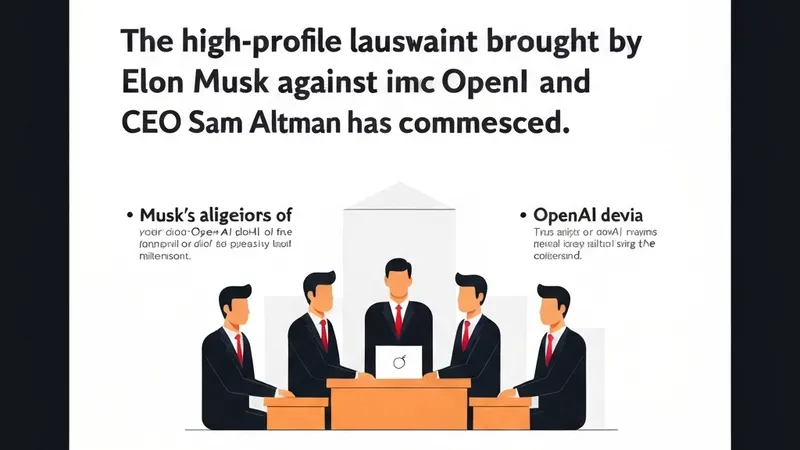
The highly anticipated legal battle between #Elon Musk and OpenAI, including its CEO #Sam Altman, commenced last week in federal court in Oakland, California.
Musk is suing OpenAI, alleging that the company has fundamentally reneged on its original mission to operate as a non-profit entity. He claims that the millions he invested in OpenAI approximately a decade ago were intended for a non-profit foundation, not a for-profit corporation. A primary remedy sought by Musk is the unwinding of OpenAI's restructuring. This includes reversing agreements like those struck in October 2025 with the attorneys general of California and Delaware, which would diminish the non-profit portion's day-to-day control over OpenAI. Musk aims to halt these changes.
The stakes of this #lawsuit are substantial. Even a partial victory for Musk could significantly impede OpenAI's reported plans for a public offering this year. Beyond the legal implications, the trial has garnered immense attention as a public spectacle, bringing the feud between two of AI's most powerful figures into federal court.
Central to Musk's argument is the claim that Sam Altman and OpenAI president Greg Brockman breached the company’s charitable trust by effectively converting OpenAI into a for-profit company. Musk alleges this conversion was contrary to the promises made to him during the company's nascent stages. In addition to unwinding the restructuring, he is seeking substantial damages and the removal of Sam Altman.
OpenAI, conversely, contends that Elon Musk was indeed aware of and agreed to the company operating a for-profit arm, recognizing the immense financial investment required to build advanced AI. Consequently, the trial will largely hinge on what Musk knew, what he didn't know, and whether he was genuinely deceived by Altman and Brockman. A significant point of contention revolves around the timeline of when Musk allegedly became aware of this misconduct, given that he co-founded OpenAI with Altman and Brockman in 2015 but filed the lawsuit in 2024, raising questions about the statute of limitations.