With dozens of companies, from agile startups to established tech giants, actively pursuing quantum computing, there is a steady flow of incremental results as they seek a viable path to practical utility. While media attention typically gravitates toward headline-grabbing breakthroughs, any ultimate success in this field will inevitably be built on a foundation of continuous, minor technical improvements.
Over the past few weeks, several quantum hardware developers have released progress reports detailing how they are steering their technologies closer to real-world applications. Though none of these announcements represents a singular massive breakthrough, they are absolutely necessary steps for the technology to mature, reflecting the relentless engineering required to deliver functional quantum systems.
Microsoft stands out as one of the few organizations pursuing topological qubits, a pathway based on the unique physics that manifest when particles are spatially confined. Microsoft’s architecture utilizes a microscopic superconducting wire deposited on top of a semiconductor. Within superconductors, electrons typically pair up into Cooper pairs. However, if the wire contains an odd number of conducting electrons—leaving a single unpaired electron—quantum mechanics dictates that this electron becomes delocalized, effectively existing at both ends of the wire simultaneously.
While theorists had long predicted this behavior, confirming that it occurs in physical devices has been a monumental challenge. Microsoft's journey has faced setbacks, including the retraction of some early academic papers in the field and widespread skepticism due to the high levels of noise in their initial experimental systems. Undeterred, the company laid out a structured development roadmap centered on building qubits from pairs of these specialized nanowires.
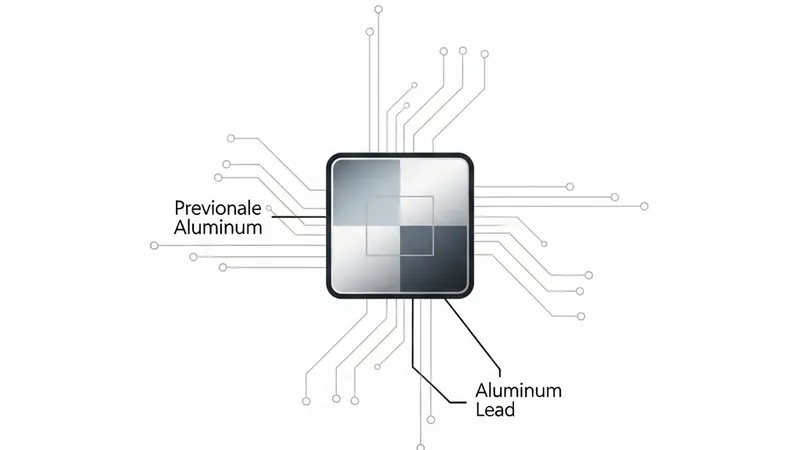
This week, Microsoft announced a major performance milestone achieved by re-engineering the materials used to fabricate its qubits. In previous iterations, aluminum served as the superconductor under near-absolute-zero conditions. The team has now replaced aluminum with lead, and reformulated the underlying semiconductor to incorporate tin. This structural adjustment has dramatically enhanced the spin-orbit coupling between the electrons in the semiconductor and those in the lead.
Microsoft's experimental devices feature two parallel wires, relying on quantum dots to measure the parity state of the pair (whether both have an extra electron, neither does, or they are in a mixed state). While the original setup was extremely noisy, with parity states spontaneously flipping every 10 milliseconds or less, the new lead-and-tin material configuration has extended the lifetime of these parity states to sometimes exceed 20 seconds. This massive improvement represents a significant stride in mitigating system noise and improving qubit coherence.
[AgentUpdate Depth Analysis] Microsoft's breakthrough in topological qubit materials marks a critical milestone that could redefine the compute architecture powering future AI Agent ecosystems. Today's AI Agents are constrained by the computational limits of classical silicon (GPUs), particularly when executing complex, long-chain reasoning, multi-agent simulations, and real-time combinatorial optimization. By extending the qubit parity state lifetime by over 2,000 times, Microsoft accelerates the timeline for Fault-Tolerant Quantum Computing (FTQC). Integrating quantum-enhanced processing with AI Agents will enable exponential speedups in heuristic search, high-dimensional decision-making, and deep semantic retrieval. This transition will liberate AI Agents from the latency and hallucination bottlenecks of current LLMs, paving the way for next-generation, truly autonomous cognitive agents capable of solving highly complex global challenges in real time.