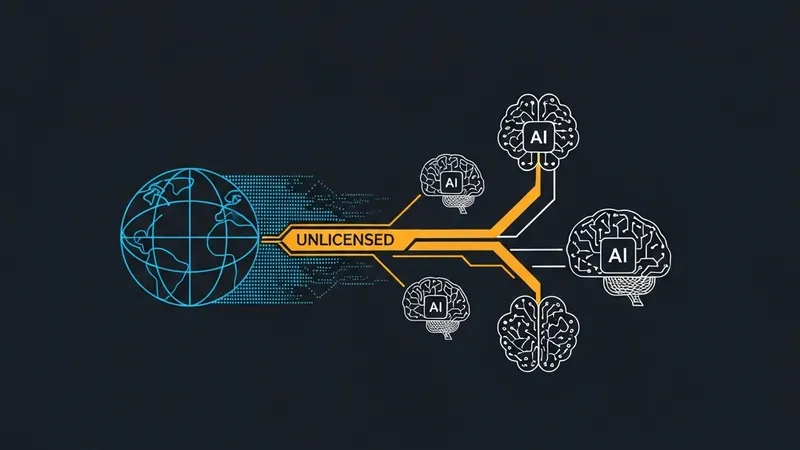
Microsoft partly trained its new MAI models on unlicensed web data, according to a recently released technical paper. As noted by technologist Simon Willison, the documentation reveals that Microsoft utilized Common Crawl and other open sources. This directly contradicts Microsoft’s previous assurances that these models were trained exclusively on "enterprise grade, clean and commercially licensed data."
Like many of its competitors, Microsoft is likely relying on the "fair use" doctrine to justify its web scraping practices. The paper describes the dataset as a "mixture of publicly available and licensed human-generated data." For web scraping, Microsoft claims to use a proprietary crawler that respects the Robots Exclusion Protocol (robots.txt) and associated meta-tags, putting the onus of content protection entirely on website owners.
This opt-out approach has drawn criticism, with skeptics comparing it to assuming consent for entry simply because a door is left unlocked. While the legal boundaries of fair use in AI training remain highly contested in court, the revelation highlights a stark contrast: Microsoft operates just like any other AI firm, despite marketing its pipeline as uniquely compliant and "clean."
[AgentUpdate Depth Analysis] This discrepancy in Microsoft's training pipeline exposes a critical vulnerability in the AI Agent ecosystem: data provenance liabilities. As autonomous Agents transition from simple wrappers to executing multi-step enterprise workflows, they act as legal extensions of the businesses deploying them. If the foundation models powering these Agents are built on disputed data, the legal and financial risks will cascade directly to enterprise users. This incident will likely accelerate the demand for "Compliance-First Agents" and verifiable data lineages. In the long run, the Agent economy will bifurcate: premium enterprise agents will strictly run on models trained on audited synthetic data or fully compensated licensing pools, while gray-area models will be relegated to low-stakes consumer tasks, reshaping the economics of foundational LLM development.