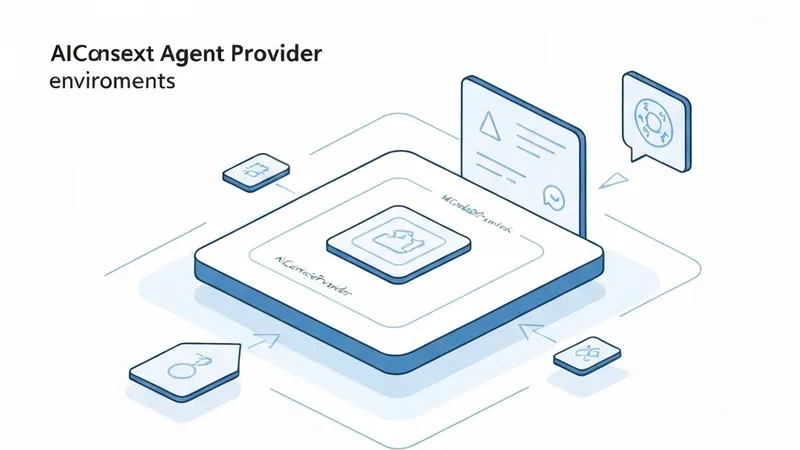
When building advanced AI agents, relying solely on fixed system prompts and tools often falls short. As the demand for more intelligent systems grows, there's a need for agents to adapt dynamically to specific situations, users, or times. For this purpose, the Microsoft Agent Framework introduces the AIContextProvider mechanism.
AIContextProviders are designed to supply dynamic context to AI agents and can be chained together to integrate data from multiple sources. These providers execute in the order they are registered, allowing for predictable layering of context modifications. You can configure this sequence in your agent's setup, ensuring that context from earlier providers is available to those that run later in the chain. This mechanism enables developers to hook into the pipeline before and after the Large Language Model (LLM) call, helping to avoid unexpected behavior by maintaining transparency in the flow.
The Architecture of Context Providers
To create a custom provider, you inherit from the AIContextProvider class. The Microsoft Agent Framework handles all the complex routing and pipeline management behind the scenes, leaving developers with just two key methods to override for custom logic:
ProvideAIContextAsync(Pre-Call): This method is invoked just before the request is sent to the LLM. At this stage, you have full access to the current session, previous instructions, and the pending message.StoreAIContextAsync(Post-Call): This method fires after the LLM has generated the response but before it is returned to the user. Here, you can analyze the final response or inspect any errors that might have occurred.
Practical Example: Agent Memory Functionality
Consider a barista agent, where we want the AI to remember the user's specific brewing habits and gear. For instance, if a user says, "I just bought a V60 pour-over" or "I really don't like acidic coffees," the agent should be able to recall this information.
In this scenario:
ProvideAIContextAsync: Is responsible for fetching existing user preferences and facts from a database and appending them as context to the LLM's instructions. For example, it might add, "User brews with a V60, prefers a 1:15 ratio, and loves dark, chocolatey roasts."StoreAIContextAsync: After the LLM generates a response, it can pass the user's request to a cheaper "extractor" agent. This extractor agent's role is to identify and save new facts from the user's conversation for future use. This enables the barista agent to continuously learn and accumulate personalized user information over time, thus providing more accurate and tailored service.
Through this approach, AIContextProvider not only enhances the adaptability of AI agents but also imbues them with learning and memory capabilities, leading to the creation of more intelligent and personalized AI applications.