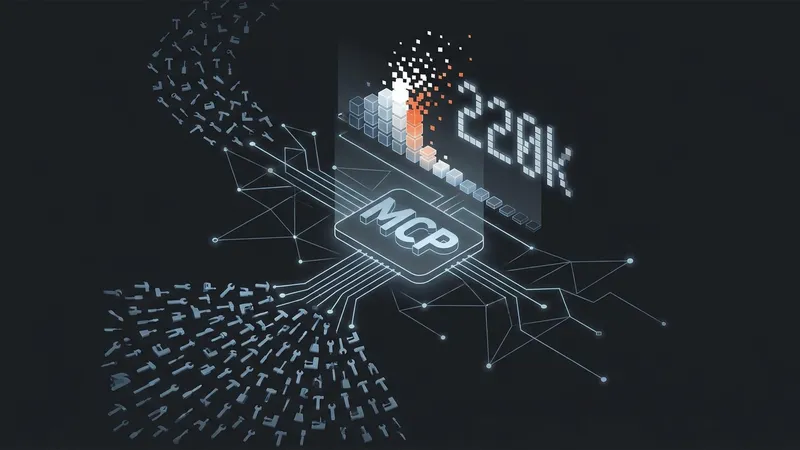
When building production-grade AI agents using the Model Context Protocol (MCP), developers frequently run into a silent token drain. Under the default MCP architecture, every tool schema from all connected servers is serialized and loaded into the LLM's context window at the very beginning of a session, before the user even types a single word. In a robust setup with 5 to 10 MCP servers and hundreds of tools, this startup overhead easily burns through 150,000 to 220,000 tokens instantly.
This full-schema loading approach suffers from severe drawbacks. Financially, assuming a rate of $3 per million input tokens and 20 active sessions per day, startup costs can balloon from $3/month to $270/month. More critically, the real issue is context headroom. If the model's context window is choked with tool definitions before the conversation even begins, there is zero space left for conversational history, retrieved documents, or multi-step reasoning. For large-scale enterprise deployments—where individual CRM or communication tool schemas can reach 5,000 tokens due to complex parameters and enums—this setup quickly hits hard physical context limits. Connecting fewer servers is a compromise, not a solution.
To bypass this bottleneck, a new design called Progressive Tool Disclosure, or the Meta-Tool Pattern, has emerged. Instead of flooding the LLM with schemas at session start, this pattern inverts the workflow by loading almost nothing initially and providing the model with two lightweight "meta-tools" to discover and invoke functions on demand:
1. discover_tools(query): A discovery tool that accepts natural language queries. When the agent realizes it lacks a specific capability, it calls this tool to retrieve relevant schemas dynamically via BM25 indexing and synonym expansion.
2. call_tool(name, arguments): A generic forwarding proxy. The agent executes a tool by passing the name and arguments to this single proxy, which forwards the payload to the appropriate underlying MCP server.
This two-tool meta-proxy setup slashes session startup token usage down to around 2,000 tokens, representing a staggering 98% to 99% reduction. As a rule of thumb, developers should adopt this proxy pattern when managing more than 50 tools or when any single tool schema exceeds 2,000 tokens; below these thresholds, conventional loading remains sufficient.
[AgentUpdate Depth Analysis] The Meta-Tool Pattern represents a pivotal architectural shift for AI Agents transitioning from experimental scripts to enterprise-grade operating systems. Traditional setups treat LLMs like workers forced to memorize massive system manuals before doing any work. In contrast, the Meta-Tool Pattern establishes an on-demand "search-and-load" mechanism, mimicking how humans lookup tools only when a specific task demands them. This decoupled execution layer sits perfectly between the LLM and transport protocols like MCP, ensuring scalability. While comparable to dynamic retrieval concepts in frameworks like LangChain, standardizing this at the protocol proxy level ensures language-agnostic compatibility. As Agentic ecosystems expand to incorporate thousands of APIs, managing context footprint via meta-agents and proxy patterns will become the foundational standard for cognitive computing.