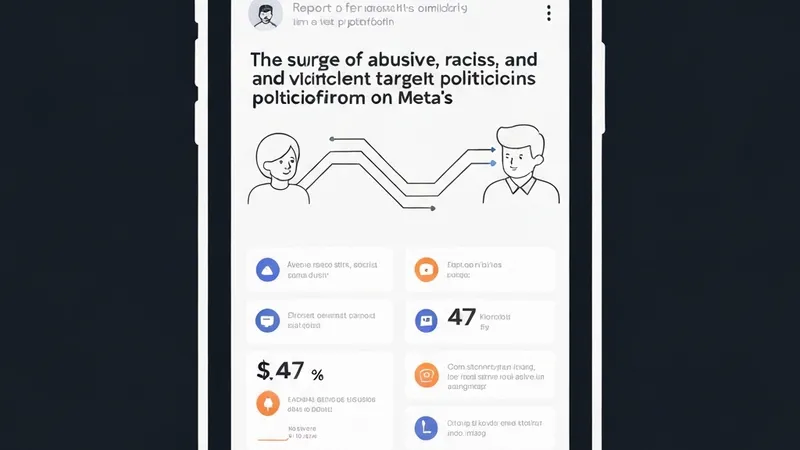
Researchers utilized an AI system trained to identify comments within the dataset that likely violated Meta's current policies on violence and incitement, hateful conduct, or bullying and harassment. The results were stark: comments violating #Meta's violent threat policies quadrupled, jumping from 1,800 in the six months prior to the policy changes to 7,600 in the six months after.
Similarly, hate speech comments also quadrupled, rising from 6,900 to 30,000. Meanwhile, comments violating rules on bullying and harassment doubled, scaling from 15,700 to 39,900.
A Meta spokesperson told WIRED that the company regularly issues public reports tracking violating content on its platforms, claiming that the prevalence of hateful conduct did not increase throughout 2025. Meta claimed it could not address the report's claims directly without seeing the research in its entirety. While WIRED provided a list of the abusive comments cited, Meta declined to comment directly. Interestingly, hours before the report's publication, many of the listed examples were quietly deleted from Facebook.
"When companies reduce oversight in areas like violence, hate, and harassment, it should not be any surprise to see those harms increase," stated Senator John Curtis, a Republican from Utah and a member of the Committee on Commerce, Science, and Transportation, in a statement to CCDH.
The data compiled by CCDH is corroborated by Meta’s own 2025 transparency reports, which indicate that the tech giant cut its proactive content moderation enforcement by roughly half following the policy adjustments. "The surge in abuse and the collapse in enforcement track one another almost exactly," the report's authors noted.
[AgentUpdate Depth Analysis] This case highlights a critical vulnerability in the current paradigm of automated moderation: the fragile balance between policy enforcement and operational overhead. As the industry transitions from manual moderation to LLM-powered safety Agents, Meta's regression shows that reducing guardrails immediately degrades system integrity. Comparing current tools, models like Llama Guard are designed to act as safety Agents, yet their real-world effectiveness is heavily bottlenecked by executive-level policy directives and computational budget cuts. In the future AI Agent ecosystem, safety cannot be treated as a static constraint. We must look toward multi-agent validation frameworks—where specialized safety Agents (such as those powered by Guardrails AI or LangGraph state machines) run parallel evaluations on platform outputs. The long-term success of autonomous AI Agents hinges on their ability to dynamically align with complex, evolving societal guardrails without sacrificing processing latency or cost-efficiency.