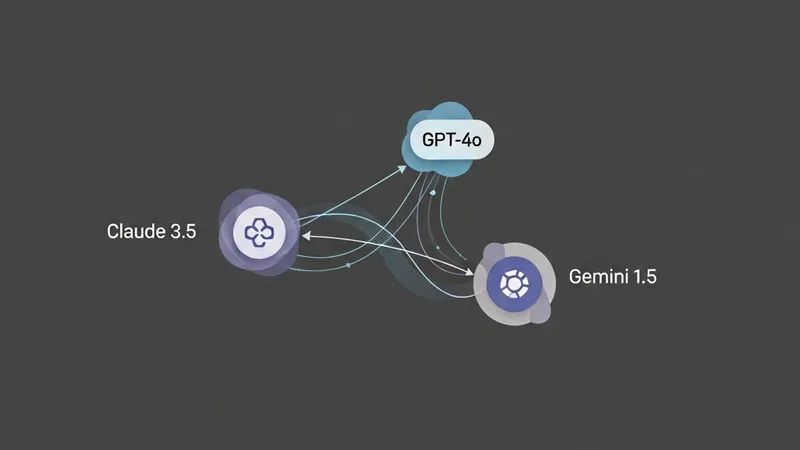
In the era of multi-model proliferation, relying on a single large language model (LLM) is no longer a viable strategy for cost-sensitive enterprise applications. To achieve real-world success, developers are actively adopting "dynamic routing" architectures. By intelligently routing user queries among Claude 3.5 Sonnet, GPT-4o, and Gemini 1.5 Pro, teams can dramatically slash API costs while enhancing real-time responsiveness.
Each frontier LLM possesses distinct competitive advantages. Anthropic's Claude 3.5 Sonnet excels in code generation, deep logical reasoning, and complex structured JSON outputs. #OpenAI's GPT-4o is the gold standard for conversational speed, multilingual consistency, and robust tool-calling stability. Meanwhile, Google's Gemini 1.5 Pro dominates long-context reasoning with its unprecedented 2-million token context window, making it ideal for large-scale document analysis.
The technical implementation of routing relies on lightweight intent-classification layers. Using open-source projects like RouteLLM or Semantic Router, engineers can leverage vector embeddings of incoming prompts to classify query complexity in milliseconds. Simple queries are dispatched to smaller, cost-efficient models, while complex tasks are routed to flagship models. This hybrid approach frequently achieves over 50% cost savings while retaining up to 95% of peak accuracy.
[AgentUpdate Depth Analysis] The shift from monolithic AI models to dynamic routing represents a fundamental evolution in the AI Agent paradigm. Rather than forcing a single model to handle everything—from basic formatting to complex code synthesis—intelligent routers act as the "cognitive dispatcher" of the workflow. Compared to static, rule-based routing, dynamic semantic-routing engines provide the flexibility needed for highly unpredictable user inputs. In the context of the AI Agent ecosystem, routing is the gateway to scalable, cost-efficient Multi-Agent systems. As agents transition into autonomous operating systems, LLM routing will function as the core kernel scheduler, allocating compute resources and model capabilities dynamically. This lowers the barrier to enterprise adoption and paves the way for resilient, self-optimizing agentic swarms.