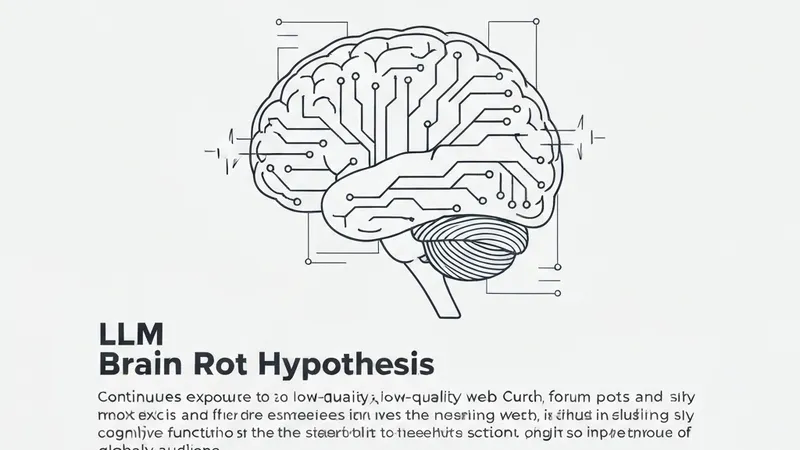
A seminal study titled "LLMs Can Get 'Brain Rot'" proposes the "LLM Brain Rot Hypothesis," positing that continuous exposure to low-quality web text induces lasting cognitive decline in large language models (LLMs). Through a novel controlled experiment conducted on real Twitter/X corpora, the research uncovers the detrimental effects of "junk data" on LLM performance.
The research team devised an experiment constructing "junk" and "reverse-controlled" datasets using two orthogonal operationalizations: M1 (engagement degree) and M2 (semantic quality). Crucially, token scale and training operations were matched across all conditions. The study found that continual pre-training of four different LLMs on the junk dataset resulted in non-trivial declines (Hedges' g > 0.3) across several key areas: reasoning, long-context understanding, and safety. Furthermore, this exposure also led to an inflation of "dark traits" such as psychopathy and narcissism.
The experiments also demonstrated a dose-response cognition decay. For instance, under M1, scores for ARC-Challenge with Chain-of-Thought dropped from 72.1 to 57.2, and RULER-CWE scores fell from 83.7 to 52.3 as the junk data ratio increased from 0% to 100%.
Error forensics provided several critical insights. Firstly, "thought-skipping" was identified as the primary lesion in reasoning, where models increasingly truncate or skip logical chains. Secondly, while instruction tuning and subsequent clean continual pre-training improved the declined cognitive abilities, they could not fully restore baseline capabilities. This suggests that the issue is rooted in persistent representational drift rather than a mere format mismatch. Finally, the study discovered that tweet popularity, a non-semantic metric, was a better indicator of the Brain Rot effect than tweet length under the M1 operationalization.
Collectively, these findings provide significant, multi-perspective evidence that social effects embedded within training data can be a causal driver of LLM capability decay during continual pre-training. This necessitates routine "cognitive health checks" for deployed and evolving LLMs to ensure their long-term performance and stability.