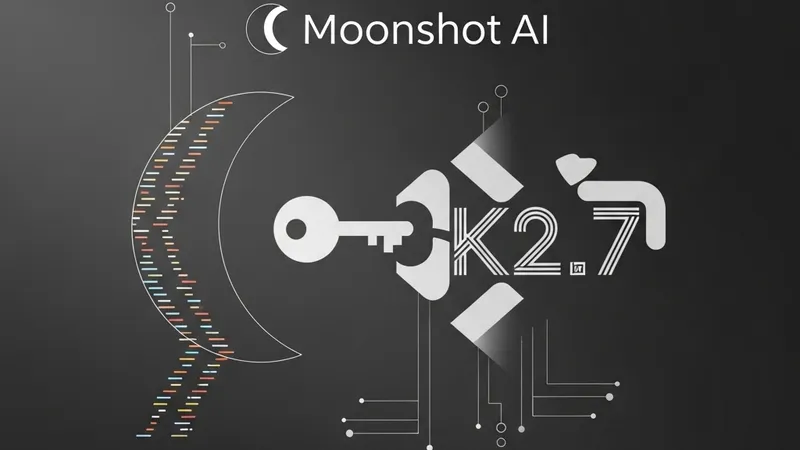
【Beijing Time】Recently, Moonshot AI, a leading Chinese artificial intelligence company, announced the official open-sourcing of its highly anticipated Kimi K2.7 code model to global developers. This move marks a significant step for domestic large models in the specialized code domain and contributes a powerful new tool to the global AI community. According to official statements, K2.7 has demonstrated "top-tier performance" across various authoritative code benchmarks, particularly excelling in complex #code generation, logical reasoning, and bug fixing scenarios.
The open-sourcing of the Kimi K2.7 model will allow researchers and developers free access to its core code for further development and customized deployment. This means that whether building automated programming tools, intelligent code assistants, or more complex AI Agent applications, a high-performance underlying support will now be available. Internal tests indicate that K2.7 achieves over 95% accuracy in code completion for popular programming languages such as Python, Java, and JavaScript, and demonstrates high practical value in refactoring and optimization suggestions for large-scale projects.
Analysts suggest that Moonshot AI's decision to #open-source Kimi K2.7 at this time aims to accelerate the application of AI in software engineering and actively participate in the global open-source ecosystem. With the rise of the AI Agent concept, models capable of understanding and generating high-quality code are becoming increasingly crucial. K2.7's release will significantly lower the barrier for developers to leverage AI in their projects, especially in building agents with autonomous programming capabilities. In the future, we anticipate the emergence of more innovative applications based on K2.7, driving leaps in software development efficiency and intelligence levels.
[AgentUpdate Depth Analysis] The open-sourcing of the Kimi K2.7 code model is undoubtedly a significant boost for the AI Agent ecosystem. Compared to existing open-source code models like Code Llama, DeepSeek Coder, or StarCoder, if Kimi K2.7 truly delivers on its promised "top-tier performance" in real-world production environments, it means agents will gain an unprecedented "programming brain." Traditional #AI Agents, when performing complex tasks, are often limited by predefined tools and API calls. An agent capable of autonomously generating, understanding, and correcting code possesses limitless potential. It can dynamically create new tools to adapt to environmental changes and even perform self-debugging and optimization. This will accelerate the evolution from single-task agents to more general-purpose agents (AGI Lite), enabling higher levels of autonomy in software development, automated operations, and scientific research. In the future, collaboration between agents will transcend mere information exchange, evolving into complex distributed intelligent systems built through code sharing and integration. Kimi K2.7 provides a more robust foundation for the Agent ecosystem, signaling agents' transformation from "tool users" to "tool creators," thereby fundamentally reshaping human-machine collaboration.