As software architectures evolve, so too must #observability tools. Distributed tracing became essential with microservices, and Jaeger emerged as a key tool for understanding these fragmented systems. Now, with generative AI applications and autonomous agents entering production, tracing requirements are shifting again. Mapping an #AI agent's execution path involves complex steps like prompt assembly, vector database retrievals, and multiple external tool calls, pushing the limits of traditional tracing.
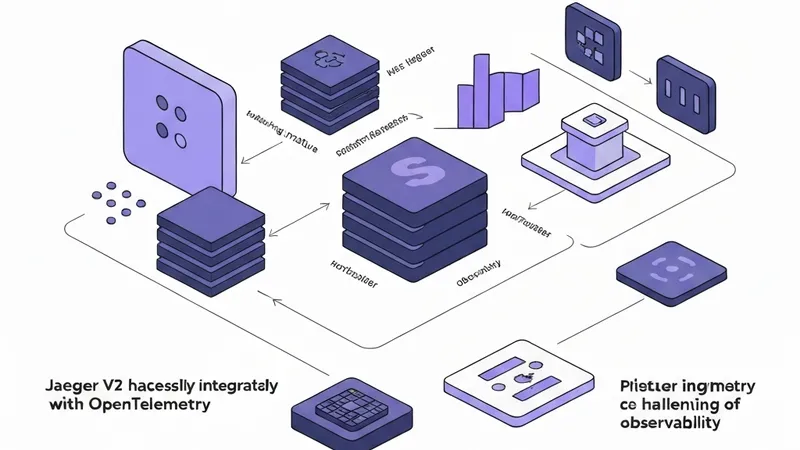
Jaeger is evolving to meet these new demands through two main phases. First, Jaeger v2 rebuilt its core architecture to natively integrate #OpenTelemetry. Second, Jaeger is expanding beyond standard data visualization by adopting the Model Context Protocol (MCP), Agent Client Protocol (ACP), and Agent–User Interaction Protocol (AG-UI). This aims to create an environment where engineers and AI agents can collaborate, helping to map the intricate execution paths of AI pipelines that often challenge existing tracing solutions.
Jaeger v2: Setting the Foundation
Managing AI workloads requires an efficient data collection pipeline, a need that guided the architectural changes in Jaeger v2. The new version replaces its original collection mechanisms with the OpenTelemetry Collector framework, consolidating metrics, logs, and traces into a unified deployment model. By natively ingesting the OpenTelemetry Protocol (OTLP), Jaeger v2 eliminates intermediate translation steps, improving ingestion performance and providing a robust data foundation for advanced tracing features.
Human and Agent Collaboration
Building on Jaeger v2, the project is exploring new methods for teams to analyze distributed systems, focusing on facilitating collaboration between engineers and AI agents during debugging. This work is actively driven by contributors from the CNCF LFX Mentorship program and Google Summer of Code (GSoC).
To support AI integration, Jaeger is adopting three open standards: the Model Context Protocol (MCP), Agent Client Protocol (ACP), and Agent–User Interaction Protocol (AG-UI). MCP standardizes how AI models securely access external data sources. ACP provides a uniform method for user interfaces to communicate with AI agents and their sidecars. Together, these protocols allow Jaeger to function as an interactive workspace.
Building the Backend Protocol Layer
The technical implementation begins in the backend. An Agent Client Protocol (ACP) layer is being built to act as a stateless translator between the Jaeger frontend and external AI sidecars. The design and proof of concept are underway.